You’ve finally settled into your home office. The coffee is hot, the blinds are open, and you are ready to tackle your to-do list. You aren’t headed to the beach, and you certainly aren’t planning on a hike. So, why are skincare experts currently insisting that you slather on SPF before sitting at your desk?
It feels a bit obsessive, doesn’t it? We have been conditioned to think of sunscreen as a “beach day” necessity, but the science of skin protection has moved indoors. When asking, “should you wear sunscreen indoor?” the answer isn’t a simple yes or no—it is a “probably,” depending on where you sit. While you might not be at risk for a painful sunburn while answering emails, your skin cells are still interacting with invisible forces that could be undoing all the hard work of your nighttime serums. Let’s pull back the curtain on what is actually happening to your skin while you stay inside.

Quick Answer: Should You Wear Sunscreen Indoors? ⚡
If you are looking for the “bottom line,” here it is: Yes, you should wear sunscreen indoors if you spend significant time near windows or in front of digital screens.
However, you don’t necessarily need the same heavy-duty, water-resistant formula you’d use at the pool. The goal of indoor sunscreen is less about preventing a red, peeling burn and more about stopping long-term “silent” damage. If you are in a windowless basement all day, you can likely skip it. But if your workspace is bathed in natural light, your skin is still very much “in the sun.”
The Real Reason: UVA Rays Don’t Stay Outside 🪟
The most dangerous misconception about sun safety is that glass is a total shield. It isn’t. To understand why you need protection, you have to understand the difference between the rays hitting your window.
- UVB (The Burning Rays): Most standard window glass is excellent at blocking UVB rays. This is why you rarely get a sunburn while sitting in your car or your living room.
- UVA (The Aging Rays): Here is the problem: can UVA rays penetrate window glass? Absolutely. Up to 50% to 75% of UVA rays pass right through clear glass.
- The Silent Damage: UVA rays penetrate deeper into the skin than UVB. They break down collagen and elastin, leading to premature wrinkles, sagging, and dark spots. Because you can’t “feel” UVA rays burning your skin, you might sit in that sun-drenched nook for hours, completely unaware that your skin is undergoing photoaging.
UVA vs. UVB vs. Blue Light 🧬
To master your indoor routine, you need to know exactly what you are fighting. Think of it as a three-front war for your skin’s health.
- UVA = “A” for Aging: These rays are present all year round, even on cloudy days. They are the primary reason for wearing broad-spectrum sunscreen inside.
- UVB = “B” for Burning: These are mostly blocked by glass, but they can still reach you if you have the windows open or are sitting on a porch.
- Blue Light (HEV): This is the high-energy visible light emitted by your laptop, smartphone, and LED bulbs. While much weaker than the sun, some studies suggest that prolonged blue light skin damage can lead to stubborn hyperpigmentation, especially in medium to dark skin tones. 💻
5 Dangerous Myths About Indoor Sunscreen 🚫
When discussing should you wear sunscreen indoor, a lot of misinformation floats around social media. Let’s clear the air by debunking the five most common myths that keep people from protecting their skin properly.
Myth #1: “No Sunlight Means No Damage”
Many believe that if they aren’t sitting in a direct beam of light, they are safe. This is false. UVA rays reflect off surfaces like white walls, mirrors, and even hardwood floors. This “indirect sunlight” still contributes to photoaging over time. If your room is bright enough to read a book without a lamp, UV rays are present.
Myth #2: “Windows Block All UV Rays”
As we established, glass is not a magic shield. While it stops the UVB rays that cause sunburns, it is almost entirely transparent to UVA rays. Sitting by a window for an eight-hour workday is equivalent to spending significant time outside without a hat. 🪟
Myth #3: “Screens Don’t Affect Skin”
While a single Zoom call won’t give you a wrinkle, cumulative blue light skin damage is a growing concern. Research suggests that High-Energy Visible (HEV) light can generate oxidative stress in the skin, potentially leading to melasma and dark spots, particularly for those with melanin-rich complexions.
Myth #4: “You Only Need Sunscreen Outdoors”
The skin doesn’t have a “GPS” that knows when you’ve stepped inside. It only reacts to the photons hitting its surface. Whether those photons came through a window or directly from the sky, the biological reaction—pigmentation and collagen breakdown—is the same.
Myth #5: “Indoor Sunscreen Is a Waste”
Some argue that the exposure levels are too low to matter. However, dermatologists often see “asymmetrical aging” in patients—where the side of the face facing a window in an office or car has significantly more wrinkles than the other. Protecting yourself indoors is an investment in your future skin. 📉
When You ACTUALLY Need Sunscreen Indoors 📍
We don’t want you to be a prisoner to your SPF. Here are the specific scenarios where indoor sunscreen is a non-negotiable part of your routine:
- Your Desk is Near a Window: If you work within 5 to 10 feet of a window, you are in the “active zone” for UVA exposure.
- You Live in a High-Altitude Area: The higher you are, the more intense the UV radiation, which penetrates glass even more effectively.
- You are Using Retinoids or Acids: If your nighttime routine includes tretinoin or Vitamin C, your skin is much more “photosensitive.” Even minor indoor exposure can cause redness. 🧴
- You Spend 8+ Hours in Front of Screens: If your job involves staring at a monitor all day, a tinted mineral sunscreen can act as a physical shield against HEV light.
When You Can Skip It (The Honest Truth) 🍃
Let’s be real: you don’t always need to be wearing sunscreen. We believe in a balanced approach that doesn’t feel like a chore. You can likely skip the SPF if:
- You Are in a Windowless Room: If you work in a basement or an interior office with zero natural light, the LED overheads are not powerful enough to cause UV damage.
- It’s Nighttime: Once the sun goes down, the UV threat disappears. Your phone screen isn’t powerful enough to require SPF 30 at 10:00 PM.
- The Blinds are Fully Closed: If you prefer working in a “cave” with blackout curtains, you are effectively shielded.
- It’s a Very Short Exposure: If you are just running into a dark room to grab a snack and coming right out, don’t stress about your application.

Blue Light and Your Skin: Is It a Real Problem? 💻
As we spend more time working from home, the phrase “blue light skin damage” has become a hot topic. But is your laptop actually aging you? The answer is nuanced.
- The Sun vs. The Screen: To put things in perspective, the sun is a million times brighter than your computer screen. You get more blue light from 15 minutes outside than you do from a whole day in front of a monitor.
- The Hyperpigmentation Link: However, for those struggling with melasma or dark spots, blue light is a genuine concern. Studies show that High-Energy Visible (HEV) light can trigger more persistent pigment changes than UV rays alone.
- Oxidative Stress: Even if it doesn’t “burn” you, blue light can create free radicals. These unstable molecules attack your skin’s structures, slowly contributing to a loss of firmness over years of exposure.
Best Type of Sunscreen for Indoor Use 🧴
When choosing an indoor sunscreen, the “feel” is just as important as the SPF rating. You want something that won’t make you feel greasy while you’re trying to focus.
- Mineral (Physical) Sunscreen: Formulas containing Zinc Oxide or Titanium Dioxide are the gold standard for indoor use. Why? Because they physically reflect light. Specifically, tinted mineral sunscreens contain iron oxides, which are currently the only ingredients proven to block blue light skin damage.
- Chemical Sunscreen: These are often more “invisible” and feel like a standard moisturizer. They are great if you hate the white cast of mineral creams, but they don’t offer the same level of blue light protection unless specifically formulated with antioxidants.
- The Lightweight Factor: Look for “milk” or “fluid” textures. Since you aren’t sweating or swimming, you don’t need a thick, water-resistant paste. 🕊️
Where to Apply Sunscreen Indoors (Most People Miss This) ✋
Most of us stop at the chin, but UVA rays are not that polite. If you are sitting sideways to a window, you need to think beyond your forehead.
- The Neck and Chest: These areas have thinner skin and fewer oil glands than your face, making them highly susceptible to photoaging and “crepy” texture.
- The Hands: Your hands are almost constantly exposed as they rest on your keyboard or mouse near a window. “Age spots” on the hands are almost entirely caused by cumulative indoor and driving exposure.
- The Ears: If you have short hair or wear it up while working, don’t forget the tops of your ears. This is a common spot for skin cancers to develop because it is so often overlooked.
How Much Sunscreen Do You Need Indoors? 📏
Don’t let the indoor setting make you stingy with your application. To get the SPF rating on the bottle, you have to use the correct amount.
- The Two-Finger Rule: Squeeze two strips of sunscreen along your index and middle fingers. This is the amount required to cover your face and neck effectively. ✌️
- The “Wait and Set” Method: Apply your sunscreen and let it sit for 10 minutes before starting your makeup or putting on your headset. This allows the protective film to “set” on your skin.
- Reapplication Reality: While the general rule is to reapply every two hours, you can be a bit more relaxed indoors. If you aren’t sweating and stay away from direct window light, one solid application in the morning is often enough to see you through a standard workday.
Best Sunscreen Features for Indoor Use 🛍️
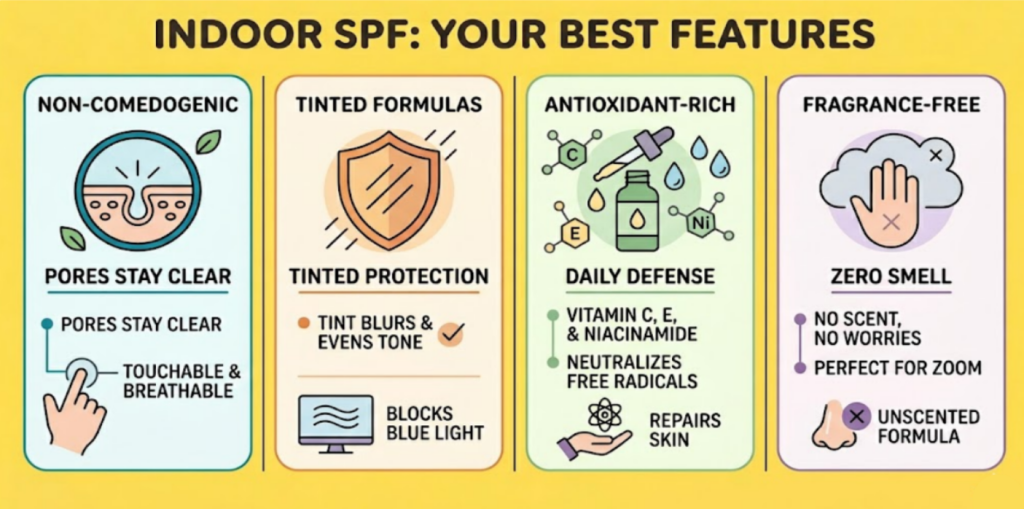
Since you aren’t fighting waves at the beach or sweat during a marathon, your indoor sunscreen criteria should focus on “wearability.” You want a product that feels like a high-end moisturizer rather than a sticky shield. Look for these specific features:
- Non-Comedogenic: This is a fancy way of saying “won’t clog your pores.” Since you’ll be wearing this while sitting still—and potentially leaning your face on your hands—you need a breathable formula.
- Tinted Formulas: As we mentioned, the iron oxides in tinted sunscreens are the secret weapon against blue light skin damage. Plus, it provides a nice “blurring” effect for those last-minute Zoom calls.
- Antioxidant-Rich: Look for ingredients like Vitamin C, Vitamin E, or Niacinamide. These help neutralize the free radicals created by the small amounts of UV and HEV light that do make it through your defenses.
- Fragrance-Free: If you are sensitive to that “sunscreen smell,” look for unscented options. There’s no reason to smell like a tropical vacation while you’re trying to finish a spreadsheet. 🥥🚫
Honest Truth: Most People Overthink This 🤔
Let’s have a heart-to-heart. Skincare should enhance your life, not cause more stress. While the question “should you wear sunscreen indoor” is medically valid, you shouldn’t feel guilty if you miss a day.
If you live in a rainy climate, work in a room with the shades drawn, or simply have a day where you stay away from the windows, your risk is incredibly low. The “skincare police” aren’t going to come for you. The goal is consistency over perfection. If you can commit to wearing SPF on the days you sit by your window, you are already ahead of 90% of the population. Don’t let the pursuit of “perfect skin” stop you from enjoying a sun-drenched breakfast nook.
Common Mistakes People Make with Indoor SPF 🚩
Even the most dedicated skincare enthusiasts often fall into these “indoor traps.” Are you making any of these errors?
- Relying on Moisturizer with SPF: While better than nothing, most people don’t apply enough moisturizer to actually get the SPF 30 rating on the bottle. It’s usually better to use a dedicated sunscreen over your cream.
- Ignoring the “Cloudy Day” Trap: Do I need sunscreen indoors on cloudy days? Yes. UVA rays are long-wave; they don’t care about clouds. They pass right through them and your windows.
- Forgetting to Reapply Before the Commute: If you’ve been inside all day and head out for a 5 PM drive, your morning application has likely worn off. Your car windows are a major source of indirect sunlight exposure. 🚗
Indoor Skincare Routine ✨
You don’t need a 10-step process to stay protected. Here is the “Lazy Girl” (or guy) guide to indoor skin health:
- Cleanse: A gentle wash to start the day.
- Hydrate: A lightweight serum or moisturizer (especially if you have the AC or heater running).
- Protect: Apply your two fingers’ worth of broad-spectrum sunscreen.
- Optional: A quick swipe of tinted lip balm or powder if you’re heading to a video meeting.
By keeping it simple, you are much more likely to actually stick to the habit. 🧘♀️
Special Case: The Working from Home Setup 💻🏠
Our modern work environments have changed the stakes for skin health. If you are part of the “laptop class,” your desk placement is your biggest risk factor. When you’re working from home, you are often stationary for hours, meaning the same patch of skin receives constant, concentrated exposure.
- The Desk Near the Window: If your desk is positioned so that the sun hits one side of your face, you are at risk for asymmetrical photoaging. Consider rotating your desk or using sheer curtains that filter light without killing the “vibe.”
- The Screen Monitor Distance: To minimize blue light skin damage, keep your monitor at least an arm’s length away. Most modern monitors also have a “Night Shift” or “Blue Light Filter” setting—turn this on! It’s better for your eyes and your skin’s oxidative stress levels.
- The “Zoom Glow” Hack: Use a tinted indoor sunscreen as your “foundation.” It protects you from the window light and the screen glow while making you look polished for the camera.
FAQs: Your Indoor Sunscreen Questions Answered 🔍
Do you actually need sunscreen indoors?
Yes, if you are near windows or spend hours in front of a computer. While you won’t get a sunburn, UVA rays through windows and blue light from screens can lead to long-term wrinkles and dark spots.
Can UVA rays go through windows?
Absolutely. Most standard glass blocks UVB (the burning rays) but allows up to 75% of UVA (the aging rays) to pass right through. If you can see the sun, the sun can “see” your skin’s collagen.
Do screens damage your skin?
While screens are much weaker than the sun, cumulative exposure to blue light (HEV) can contribute to hyperpigmentation, particularly in those with melasma or darker skin tones.
Is indoor sunscreen necessary on cloudy days?
Surprisingly, yes. UVA rays are persistent. They penetrate through thick clouds and glass alike. If it’s daylight outside, the aging process is technically active. ☁️
Final Verdict: Should You Wear Sunscreen Indoors or Not? 🏁
So, what is the “honest truth”? Learning should you wear sunscreen indoor isn’t about fear—it’s about smart prevention.
If you are spending your day in a sunlit home office or glued to a high-definition monitor, wearing a lightweight SPF is one of the easiest “anti-aging” hacks available. It protects the investment you’ve made in your other skincare products and keeps your moisture barrier resilient. However, if you’re relaxing in a dim room or it’s a rainy evening, feel free to give your skin a break.
Consistency is the secret to a lifetime of healthy skin. Find a formula you love, put it on your desk, and make it part of your “start work” ritual. Your skin will thank you ten years from now! 🌟✨
References
- Is it necessary to wear sunscreen indoors
- Factors affecting wavelength-resolved ultraviolet irradiance indoors and their impacts on indoor photochemistry
- Indoor UV Exposure: A Hidden Risk
- Can Light Emitted from Smartphone Screens and Taking Selfies Cause Premature Aging and Wrinkles?