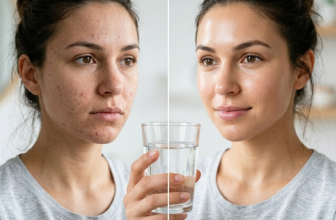
Oral collagen for skin has become one of the most debated beauty trends of 2026. But does oral collagen actually work for skin, or is it just marketing?

If you walk into any health store in 2026, you’ll see rows of powders promising “youth in a scoop.” But as a clinician, I hear the same skeptical question every day: “If my stomach acid just dissolves the collagen, how can it possibly reach my face?”
It’s a valid question. For years, the scientific community dismissed collagen supplements as “expensive protein powder.” However, recent breakthroughs in peptide signaling science have shifted the narrative. To understand the collagen myth vs. reality 2026, we have to move past the marketing and look at the molecular biology of the skin.
The Myth: “Collagen Goes Straight to Your Skin”
Oral collagen for skin refers to hydrolyzed collagen peptides taken as a supplement to support skin elasticity and dermal structure. Unlike topical collagen creams, oral collagen for skin works systemically through peptide signaling.
Marketing campaigns often portray collagen as a direct delivery system. The simplified story suggests that when you drink a collagen latte, those fibers travel through your gut, enter your blood, and “plug” the gaps in your sagging skin.
This is a physiological impossibility. Collagen, in its whole form, is a massive, triple-helix protein. Your gut cannot absorb it whole. Thinking that eating collagen directly becomes skin collagen is like eating a suede jacket and expecting it to turn into a new layer of skin on your arm.
What Actually Happens When You Eat Collagen?
The Bioavailability Debate
When you consume collagen, it meets your stomach acid and digestive enzymes (like pepsin).
Can stomach acid destroy collagen? Not exactly “destroy,” but it certainly deconstructs it. Your body breaks this long protein chain down into its building blocks: the amino acids Proline, Hydroxyproline, and Glycine.
Why “Hydrolyzed” Matters
This is where the hydrolyzed collagen peptides bioavailability debate comes in.
- Whole Collagen: Too large to be absorbed.
- Hydrolyzed Peptides: These are “pre-broken” fragments. In 2026, we focus on low-molecular-weight peptides (measured in Daltons, typically 2–5 kDa). These small chains are short enough to survive the initial digestive process and cross the intestinal wall intact.
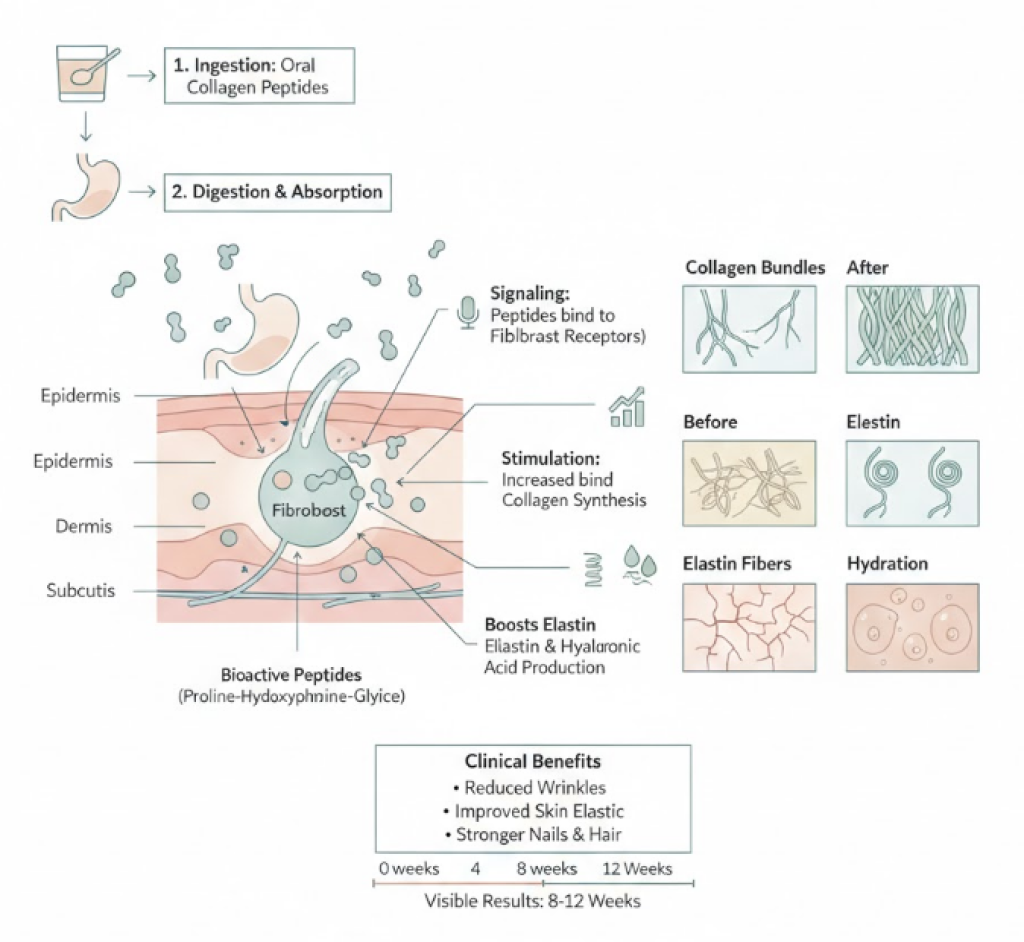
How Oral Collagen for Skin Works Through Peptide Signaling
If collagen doesn’t “fill” your skin, how does it work? This is the most fascinating part of modern dermatology: Gly-Pro-Hyp signaling.
When these small, hydrolyzed peptides enter your bloodstream, your body doesn’t just see them as “food.” It sees them as signs of damage.
1. The Trigger: Your body detects an influx of “broken” collagen fragments in the blood.
2. The False Alarm: Your brain thinks, “If there are so many collagen fragments, the skin must be breaking down!”
3. The Response: It sends a signal to your Dermal Fibroblasts (the factory cells in your skin).
4. The Result: The fibroblasts “wake up” and begin producing brand-new, high-quality Type I and Type III collagen within the Extracellular Matrix (ECM).
This is a sophisticated expansion strategy. By addressing these specific high-intent clusters, you move the article from a standard “guide” to a definitive, “white-paper” style pillar page.
Natural Food Sources of Collagen (And Do They Work?)
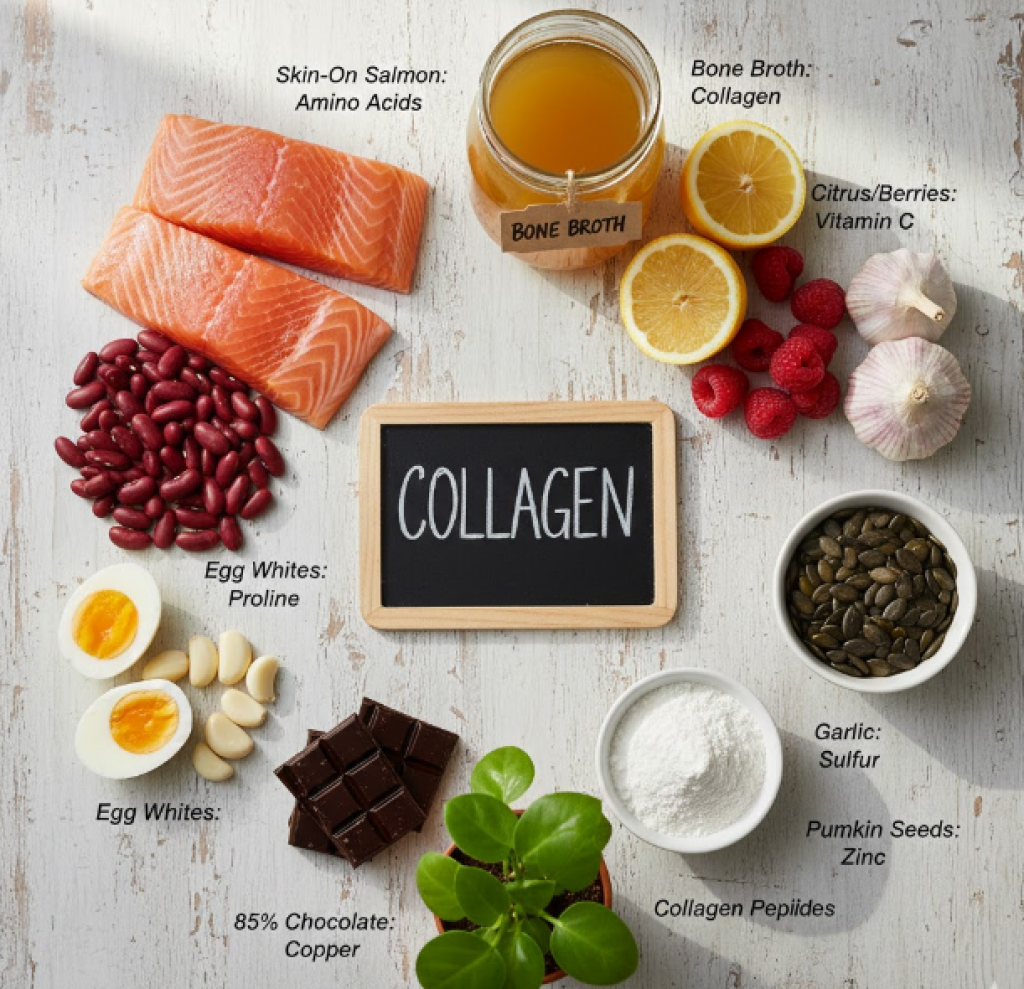
While supplements offer a convenient, concentrated dose, the question remains: can I rebuild skin collagen naturally with food? The answer is nuanced. You don’t “eat” collagen and have it plug directly into your dermis; your body breaks it down into amino acids—specifically proline, glycine, and hydroxyproline—and redistributes them based on metabolic priority.
Top Collagen-Rich Foods List
- Bone Broth: Simmering animal bones extracts Type I collagen and gelatin. It is rich in the amino acids necessary for skin repair, though levels vary by batch.
- Chicken Skin & Connective Tissue: Modern “boneless, skinless” diets miss out on the richest natural sources of Type II collagen found in cartilage.
- Fish Skin: Marine collagen is highly bioavailable due to its smaller peptide size. Eating the skin of salmon or mackerel provides a direct source of Type I collagen.
- Egg Whites: While they don’t contain collagen fibers, they are exceptionally high in proline, one of the primary building blocks for human collagen synthesis.
The Role of Cofactors (The “Construction Crew”)
Collagen production is a complex enzymatic process. Without “cofactors,” your body cannot assemble the amino acids you consume.
- Vitamin C: The essential “glue.” It acts as a cofactor for the enzymes that cross-link collagen fibers.
- Zinc & Copper: These minerals activate the “lysyl oxidase” enzyme required for functional collagen maturation.
| Food Source | Primary Collagen Type | Main Skin Benefit |
| Bone Broth | Type I & III | Support for skin density and gut lining. |
| Sardines/Fish Skin | Type I (Marine) | Highest bioavailability for dermal elasticity. |
| Chicken Cartilage | Type II | Joint cushioning and systemic hydration. |
| Citrus/Berries | N/A (Vitamin C) | Essential catalyst for new fiber synthesis. |
The Professional Take: Whole foods provide the raw materials, but the body often prioritizes internal organs or wound healing over “aesthetic” skin repair. Supplements “game” the system by flooding the bloodstream with specific peptides that act as a biological signal to produce more collagen in the skin.
Who Should Consider Collagen Supplementation?
Not everyone needs a daily collagen scoop. Understanding your biological “collagen clock” helps manage expectations.
Ideal Candidates
- Adults 35–40+: This is the “tipping point” where collagen fragmentation exceeds production.
- Post-Menopausal Women: Estrogen levels are closely tied to collagen density; a 30% drop in skin collagen is typically observed in the first five years of menopause.
- High Sun Exposure: UV rays trigger “matrix metalloproteinases” (MMPs)—enzymes that chew up existing collagen. Supplementation can help offset this accelerated degradation.
Who Should Skip It (Or Use Caution)?
- The “Instant Results” Seeker: Collagen is a “slow-burn” supplement. If you expect wrinkles to vanish in 48 hours, you will be disappointed.
- Severe Skin Laxity: If the skin has lost significant structural integrity due to extreme weight loss or advanced aging, supplements cannot mimic a surgical lift.
- Allergy Risks: Those with shellfish or fish allergies must be vigilant; marine collagen is a common trigger.
Vegan Collagen vs. Animal Collagen: What’s the Truth?
The term “Vegan Collagen” is technically a misnomer. Collagen is a protein found only in animals.
- Plant-Based “Boosters”: Most vegan products are actually a blend of Vitamin C, Silica, and amino acids. They support your body’s existing production but do not add new collagen to the system.
- The 2026 Trend: Fermentation Collagen: We are finally seeing the rise of “Lab-Grown” vegan collagen created through microbial fermentation. These bio-identical human collagen sequences are the future for those avoiding animal products, though they remain significantly more expensive than bovine options.
Best Oral Collagen for Skin: Marine vs Bovine Compared
The choice usually comes down to sourcing.
| Feature | Marine Collagen | Bovine Collagen |
| Source | Fish skin/scales | Cow hides |
| Type | Mostly Type I (Skin-focused) | Type I & III (Skin & Joint) |
| Absorption | 1.5x more efficient (smaller peptides) | Standard |
| 2026 Safety | Heavy metal testing is vital | Grass-fed/BSE-free is vital |
Is marine collagen safer?
Generally, yes, for skin specific goals, as its peptides are smaller and more “bio-identical” to human Type I collagen. However, you must look for brands that provide collagen supplement heavy metal testing 2026 to ensure no mercury or lead contamination.
Is Collagen Safe? Heavy Metals, Testing & Quality Control
In 2026, the primary concern isn’t if collagen works, but how clean it is. Because collagen is derived from animal byproducts, it can act as a bio-accumulator for environmental toxins.
Heavy Metal Contamination
Marine collagen can carry traces of mercury and lead, while bovine sources can be linked to pesticides if the cattle weren’t grass-fed.
- The Fix: Always look for Third-Party Testing (NSF, USP, or Informed-Choice). This ensures a lab independent of the manufacturer has verified the purity.
The Microplastic Concern
With rising ocean pollution, “wild-caught” marine collagen must now be screened for microplastic residues. Premium brands in 2026 now provide “Batch Transparency Reports” via QR codes on the packaging.
Collagen Supplements vs. Retinol vs. Microneedling
| Treatment | Mechanism | Evidence Strength | Visible Results Speed |
| Collagen Peptides | Systemic signaling | Moderate/High (Oral) | 8–12 Weeks |
| Retinol/Tretinoin | Gene expression | Gold Standard (Topical) | 12–24 Weeks |
| Microneedling | Controlled wound repair | High (Physical) | 4–6 Weeks |
The Synergy: Don’t view these as competitors. Retinol tells your cells to work harder; Collagen Peptides provide the fuel to do that work; Microneedling forces a “reset” of the entire system.
Why Collagen Doesn’t Work for Everyone
If you’ve taken collagen for a month and seen no change, one of these “Success Killers” is likely to blame:
- Inadequate Dosage: Many “beauty gummies” contain less than 1g of collagen. Clinical success is typically seen at 5g to 10g daily.
- Lifestyle Sabotage: If you smoke or consume a high-sugar diet (which causes “glycation”—the stiffening of collagen fibers), you are destroying collagen faster than you can replace it.
- Low Vitamin C Status: Without enough Vitamin C, your body can’t convert those expensive peptides into functional skin tissue.
- The “Duration Gap”: Skin turnover takes roughly 28–40 days. It takes at least two full cycles of skin renewal to notice a systemic change in texture or hydration.
How to Take Collagen for Maximum Bioavailability
- The Empty Stomach Myth: There is no significant evidence that taking collagen on an empty stomach improves absorption. It is best taken whenever you can be consistent.
- With Vitamin C: If your supplement doesn’t include it, take it with a squeeze of lemon or a bowl of berries.
- Temperature Matters: High-quality hydrolyzed peptides are heat-stable. You can stir them into hot coffee without damaging the nutritional profile.
- Consistency > Timing: A morning dose vs. a nightly dose matters less than ensuring you don’t miss days. Collagen signaling is a cumulative process.
Collagen: The 60-Second Summary
- ✔ Digested into peptides: It doesn’t stay a whole protein; it breaks down into “messenger” molecules.
- ✔ Acts as a signal: It “tricks” your skin into thinking there is a breakdown, triggering a repair response.
- ✔ Modest, steady results: Expect improvements in hydration first, then fine lines after 8–12 weeks.
- ✔ Best for 40+ skin: Becomes more effective as your natural production slows down.
- ✔ Quality over Hype: Prioritize third-party tested, grass-fed, or wild-caught sources over flashy marketing.
Myth vs. Reality Breakdown
❌ Myth: Collagen works in a week.
✅ Reality: It takes 8–12 weeks for the “signaling” process to result in visible skin density changes.
❌ Myth: Vegan collagen is the same thing.
✅ Reality: Most “vegan collagen” contains no collagen; it is simply a “booster” of Vitamin C and Silica.
❌ Myth: All collagen is the same.
✅ Reality: Molecular weight is king. If the peptides are too large, you’re just buying expensive amino acids.
FAQ: People Also Ask
1. Is eating collagen better than applying it topically?
Yes. Topical collagen molecules are usually too large to penetrate the dermis; they just sit on top and hydrate. Oral peptides reach the fibroblasts from the inside, where the actual building happens.
2. Does collagen powder help with sagging skin?
It can improve elasticity (the “snap-back”), but it will not fix severe skin laxity or replace the need for a surgical facelift.
3. Can I rebuild skin collagen naturally with food?
Yes. By consuming high-quality protein (bone broth, eggs) and pairing it with Vitamin C (a required co-factor for collagen synthesis) and avoiding UV damage, you can support your body’s natural production.
The Final Verdict
Does oral collagen actually work for skin? Yes, but with caveats. It is not a “magic pill,” and it won’t undo a pack-a-day smoking habit or a lifetime of sun damage.
However, for those over 40—when our natural collagen production drops by 1% every year—taking a low-molecular-weight, hydrolyzed peptide supplement can significantly improve skin hydration, reduce fine lines, and support the structural integrity of your face.
References
- Kim J, et al. (2022) – Oral low‑molecular‑weight collagen peptides reduce skin wrinkles and improve skin properties.
https://pubmed.ncbi.nlm.nih.gov/36516059/ - Asserin J, et al. (2015) – Oral collagen peptide supplementation improves skin moisture and dermal collagen network.
https://pubmed.ncbi.nlm.nih.gov/26362110/ - Czajka A, et al. (2018) – Daily oral collagen peptides with bioactives improved skin elasticity vs placebo.
https://pubmed.ncbi.nlm.nih.gov/30122200/ - Pu SY, et al. (2023) – Systematic review/meta‑analysis: hydrolyzed collagen supplementation increases skin hydration & elasticity.
https://pubmed.ncbi.nlm.nih.gov/37432180/ - Seong H, et al. (2024) – Low‑molecular‑weight collagen peptides improved skin hydration, elasticity, wrinkles in a clinical trial.
https://pubmed.ncbi.nlm.nih.gov/37822045/