⚠️ MEDICAL DISCLAIMER: READ BEFORE PROCEEDING
IMPORTANT: Tretinoin is a powerful, medical-grade prescription drug, not a standard cosmetic cream. It is extremely potent and should be used only if suggested by a dermatologist or skin professional.
The information provided in this article is for educational and informational purposes only and does not constitute professional medical advice, diagnosis, or treatment. Improper use of tretinoin can lead to severe chemical burns, permanent skin thinning, or systemic health risks. Never attempt to acquire or use tretinoin without a valid doctor’s recommendation. If you experience intense burning, swelling, or signs of an allergic reaction, stop use immediately and seek medical attention.
So, you finally got your hands on a tube of tretinoin. You’ve heard the legends about its ability to erase wrinkles and stop acne in its tracks. You applied it with high hopes, but three days later, you woke up looking like a shedding lizard. Your face is tight, your favorite moisturizer stings, and you are currently wondering: Is this even worth it? 🦎
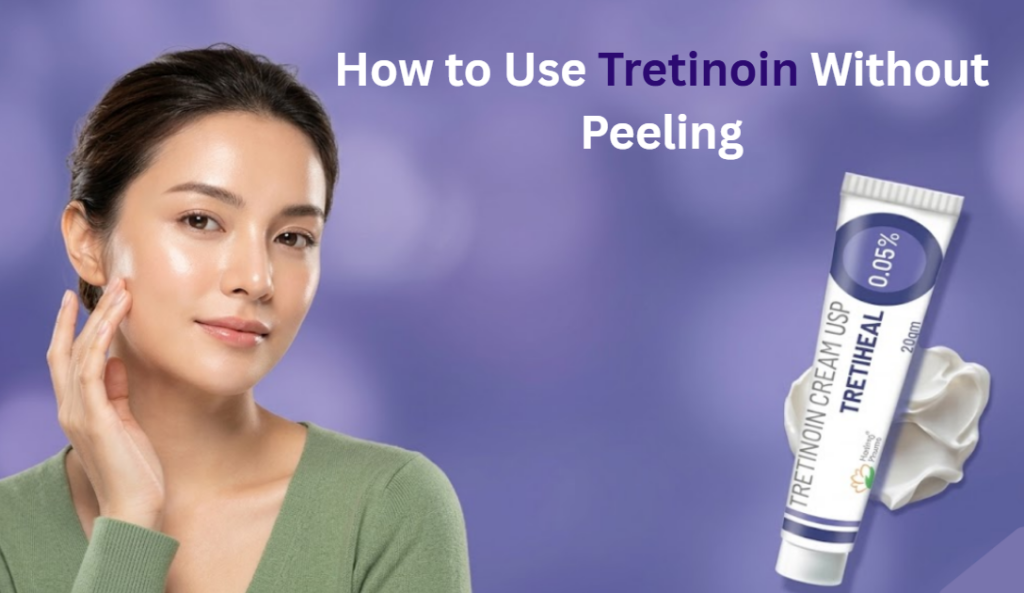
Believe it or not, this “initial shock” is the most common reason people give up on their skincare journey. But here is the secret: you don’t have to suffer to see results. Learning how to use tretinoin without peeling isn’t about finding a “magic” product; it’s about mastering a specific technique that protects your skin barrier while the medicine does its work. In this guide, we will break down the common mistakes that lead to that raw, flaky mess and show you the exact steps to achieve that famous “tretinoin glow” without the painful side effects.
Why Tretinoin Causes Peeling in the First Place 🧪
Before we can fix the problem, we have to understand the science. Why does this cream make your skin literally fall off? The answer lies in how tretinoin (Retin-A) interacts with your biology.
- Accelerated Cell Turnover: Normally, your skin cells take about 28 days to travel from the bottom layer to the surface and shed. Tretinoin puts this process on fast-forward. Your skin starts pushing new cells to the surface every few days. Your body simply cannot shed the old, dead cells fast enough, leading to visible flaking.
- Skin Barrier Disruption: Tretinoin temporarily thins the “stratum corneum” (the outermost layer of your skin). While this is great for smoothing texture, it also makes your skin less efficient at holding onto moisture.
- Transepidermal Water Loss (TEWL): Because that top layer is thinner, water evaporates out of your skin much faster than usual. This leads to tretinoin dry skin that feels tight, itchy, and sensitive. 💧
Is Peeling Normal or a Sign You’re Doing It Wrong? 🤔
This is the golden question. Many users think that if they aren’t peeling, the product isn’t working. This is a myth.
- Mild Flaking: A little bit of light “dusting” around the nose or mouth during the first few weeks is completely normal. It’s a sign your skin is adjusting.
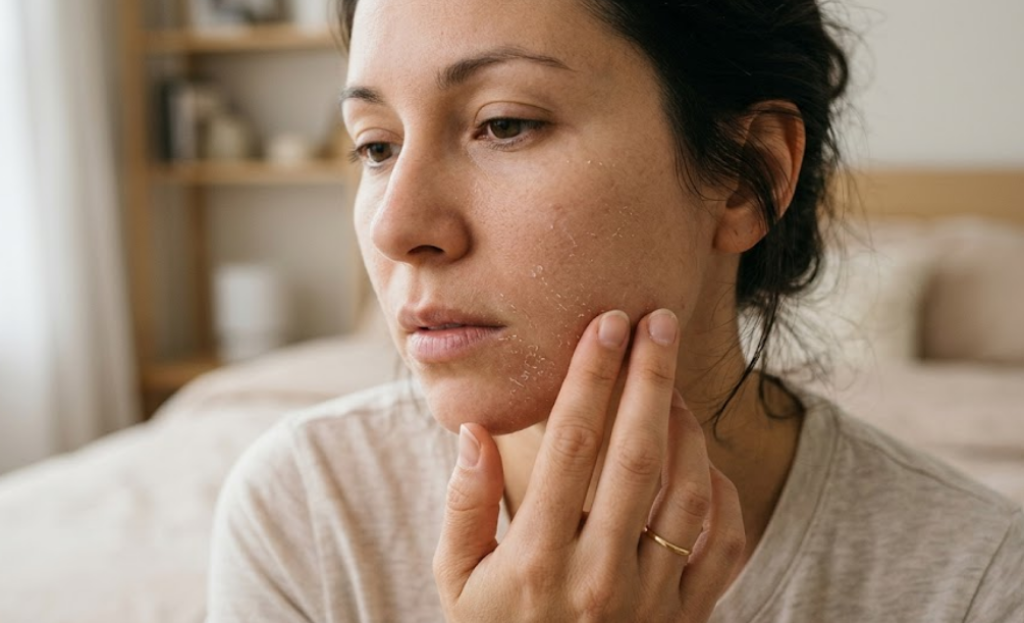
- The Danger Zone: If your skin is red, weeping, stinging when you apply plain water, or peeling in large, painful “sheets,” you are dealing with tretinoin irritation, not a normal adjustment phase.
- The Goal: You want to reach a state of “retinization” where your skin is transforming behind the scenes, but your surface barrier remains calm and hydrated. If you are in pain, you are moving too fast. 🛑
The Biggest Mistakes That Cause Severe Peeling 🚩
Most users accidentally sabotage their own progress. Are you guilty of any of these tretinoin irritation causes?
- Using Too Much: This isn’t a moisturizer. If you are using a “glob” of cream, you are overloading your skin’s receptors. A pea-sized amount is the medical standard for your entire face.
- The “Damp Skin” Error: Applying tretinoin to a face that is even slightly damp is a recipe for disaster. Water acts as a carrier, pulling the tretinoin deeper and faster into the skin than intended.
- The Daily Start: Jumping into daily use from night one is the fastest way to ruin your moisture barrier. Your skin needs time to build up its tolerance.
- Mixing Actives: Using Vitamin C, Salicylic Acid, or Glycolic Acid in the same routine as your tretinoin is like pouring gasoline on a fire. ⛽️🔥
9 Proven Ways to Use Tretinoin Without Peeling 🛠️
If you are tired of the constant flaking, you need a strategic approach. You cannot simply “power through” a damaged skin barrier. Instead, you must use these nine proven methods to teach your skin how to tolerate the medication without the drama.
- Start Slow (The 2-3 Nights Rule)
The biggest mistake is over-eagerness. Your skin needs a “get to know you” phase with Vitamin A. Start by applying tretinoin only two or three nights per week. Space these nights out evenly (e.g., Monday and Thursday). Once your skin can handle this for two weeks without tretinoin irritation, you can slowly increase the frequency.
- Master the “Pea-Sized” Rule
More product does not mean faster results; it only means more tretinoin dry skin. Imagine a standard green pea. That tiny amount is all you need for your entire face. Dot it on your forehead, cheeks, and chin, then blend outward. Avoid the corners of your nose and eyes, where the skin is thinnest and most prone to cracking. 🟢
- Apply on Completely Dry Skin
As we mentioned earlier, moisture is a conductor. To prevent the tretinoin from diving too deep, wait at least 20 to 30 minutes after washing your face before applying the medication. This ensures your “acid mantle” has settled and there is no residual water to accelerate absorption.
- Use the Legendary “Sandwich Method”
This is the “holy grail” for preventing retinoid dryness. 🥪
- Step 1: Apply a thin layer of basic moisturizer to clean skin.
- Step 2: Wait 10 minutes, then apply your pea-sized amount of tretinoin.
- Step 3: Apply a second, thicker layer of moisturizer on top. This buffers the tretinoin, creating a safety net that delivers the benefits without the bite.
- Choose a Barrier-Repairing Moisturizer
Not all lotions are created equal when you are on tretinoin (Retin-A). You need a formula rich in ceramides, fatty acids, and cholesterol. These ingredients mimic your skin’s natural lipids and help “glue” your skin cells back together when they start to flake.
- Avoid Mixing with Harsh Actives
While you are in the adjustment phase, put your exfoliating brushes, AHA/BHA toners, and physical scrubs in the cabinet. Your skin is already exfoliating at a massive rate; adding chemical or physical scrubs will lead to a moisture barrier disruption that can take weeks to heal.
- Always Use Sunscreen (Non-Negotiable)
Tretinoin makes your skin hyper-sensitive to UV rays. Even a few minutes of unprotected sun exposure can cause a “retinoid burn” that looks like peeling but is actually sun damage. Use a broad-spectrum SPF 30 or higher every single morning, regardless of the weather. ☀️
- Don’t Overwash Your Face
If your skin feels tight, stop using foaming or “deep clean” cleansers. These strip your natural oils. Switch to a gentle, non-foaming cream or oil cleanser that leaves your skin feeling soft rather than “squeaky clean.”
- Be Patient (The 6-Week Adaptation)
Your skin usually takes about 6 to 8 weeks to fully adapt to a new retinoid. During this time, you might have good days and bad days. Don’t panic and quit. As long as you aren’t experiencing intense burning or swelling, stay the course with these tips to reduce tretinoin irritation. 🗓️
The Best Moisturizers to Prevent Tretinoin Dryness 🧴
When you are on a prescription retinoid, your standard “oil-free” moisturizer might not cut it anymore. You need a product that focuses on moisture barrier disruption and repair. Look for these specific “powerhouse” ingredients on the label:
- Ceramides: These are the “mortar” between your skin cell “bricks.” They are essential for sealing in moisture and keeping irritants out.
- Hyaluronic Acid & Glycerin: These are humectants that pull water into the skin. However, always follow them with a thicker cream to “lock” that water in, or you may actually increase transepidermal water loss.
- Squalane & Shea Butter: These occlusives provide a protective seal on the surface, mimicking your skin’s natural oils which are often depleted during the first few weeks of treatment.
- Panthenol (Pro-Vitamin B5): This is a soothing superstar that helps calm the redness associated with tretinoin irritation. 🌿
How Long Does Tretinoin Peeling Last? ⏳
One of the most common questions is: “When will my face stop falling off?” Understanding the timeline is key to staying consistent.
- The Initial Shock (Weeks 1–2): You might not see peeling immediately. It often takes 3 to 4 days for the cell turnover to kick in. This is when the “dusting” begins.
- The Peak (Weeks 3–5): This is usually the height of the adjustment period. If you are going to experience tretinoin dry skin, it will be most intense during this window.
- The Adaptation (Weeks 6–8): Your skin’s “retinization” process should be nearing completion. You will notice that the flaking becomes less frequent and your skin feels less reactive to your daily routine.
- The Long-Term Glow (3 Months+): By now, the peeling should be a distant memory. Your barrier has thickened, and you are left with the smooth, clear results you’ve been waiting for. 🗓️✨
Should You Stop Using Tretinoin If Your Skin Peels? 🛑
The instinct to quit when things get “ugly” is strong, but stopping completely can actually reset your progress.
- When to Continue: If you have mild flaking and “tightness” but no pain, keep going! Use the “Sandwich Method” and reduce your frequency, but don’t stop.
- When to Pause: If your skin is bright red, stinging when you apply even the gentlest moisturizer, or if you have open “raw” spots, you need a tretinoin break. Stop for 3 to 5 days and focus exclusively on hydration until the stinging stops.
- The “Slow Re-Entry”: Once your skin has calmed down, don’t jump back in at your old frequency. Start back at once or twice a week and listen to your skin’s signals.
Signs Your Skin Barrier Is Damaged 🚩
It is vital to know the difference between “normal adjustment” and a damaged skin barrier. If you ignore these signs, you could be looking at weeks of recovery time.
- The “Orange Peel” Texture: Your skin looks shiny but feels incredibly dry and has tiny, exaggerated pores.
- Product Stinging: Even “safe” products like basic cleansers or plain water cause a burning sensation. 🥵
- Persistent Redness: Your face looks perpetually sunburnt, even if you haven’t been outside.
- Sudden Sensitivity: You are breaking out in itchy, tiny bumps that don’t look like your typical acne (this could be a sign of dermatitis).
How to Repair Your Skin Barrier Fast 🚑
If you have already crossed the line into skin barrier damage, don’t panic. You can fix it, but you must be disciplined. Use this “Rescue Protocol” to get your skin back to a healthy state:
- The Total Active Fast: Immediately stop using tretinoin, Vitamin C, and any acids. Your skin is “raw,” and it needs zero interference. 🛑
- Skip the Morning Cleanser: Stop washing your face in the morning with soap. Simply splash with cool water. This preserves the precious natural oils your skin produced overnight to try and heal itself.
- The “Slug” Method (PM Only): After your moisturizer at night, apply a very thin layer of a petrolatum-based ointment (like Aquaphor or CeraVe Healing Ointment). This creates an artificial barrier that stops transepidermal water loss completely, allowing the skin underneath to knit back together.
- Cold Compresses: If your face feels hot or “pulsing,” apply a clean, cold cloth for 5 minutes. This constricts blood vessels and reduces the inflammatory “fire.”
Tretinoin for Sensitive Skin: Special Tips 🧘♀️
Having reactive skin doesn’t mean you can’t use retinoids; it just means you need a different strategy. If you have “finicky” skin, follow these adjustments:
- Short-Contact Therapy: This is a game-changer. Apply your tretinoin to clean, dry skin, leave it on for 30 to 60 minutes, and then wash it off with a gentle cleanser before applying your moisturizer. Research shows you still get the cellular benefits, but with significantly less tretinoin irritation. 🧼
- The “Micro” Formula: Ask your doctor about “Microsphere” technology. Unlike the traditional cream, the micro-gel releases the tretinoin slowly over several hours, which is much kinder to sensitive barriers.
- Buffer Every Time: Don’t even think about applying tretinoin to bare skin. Always use the “Sandwich Method” we discussed in Section 5.4.
Can You Use Moisturizer with Tretinoin? 💧
We still see this question constantly: “Will moisturizer make the tretinoin stop working?” The answer is a resounding no. In fact, using a moisturizer with tretinoin is often the only way to ensure long-term success. While a thick cream might slightly slow down the absorption rate, it does not stop the molecule from reaching its target. For 95% of users, the trade-off—slightly slower absorption in exchange for zero retin-a drying skin—is a massive win. Consistency is the most important factor in skincare; a “diluted” tretinoin used 5 nights a week is infinitely better than a “pure” tretinoin that burns your face so badly you can only use it once a month.
Does Tretinoin Make Skin Worse Before Better? 🌋
It is important to distinguish between tretinoin purging and simple irritation.
- The Purge: This is when you see an increase in breakouts. Tretinoin is clearing out “clogs” that were already forming under the surface. This is a sign of increased cell turnover and is actually a good thing in the long run.
- The Irritation: This is the peeling, redness, and stinging we’ve been talking about.
- How to Tell the Difference: Purging happens in areas where you normally break out. If you are suddenly getting tiny, itchy bumps in areas where you never get pimples, that is likely tretinoin irritation or a damaged barrier, not a purge. 🔍
Honest Truth: You Don’t Need Peeling for Results 💡
One of the most dangerous myths in the skincare world is “no pain, no gain.” Many users believe that if they aren’t suffering from tretinoin dry skin, the product isn’t working. This is completely false.
The goal of tretinoin is to communicate with your DNA to stimulate collagen production and regulate cell turnover. This happens at a microscopic level. Visible peeling is simply a side effect of the surface skin being overwhelmed. If you use the “Sandwich Method” and your skin looks calm, hydrated, and normal, the tretinoin is still doing its job deep in the dermis. In fact, keeping your skin calm allows you to be more consistent, which leads to better results over time. 📈
Daily Routine Example (Beginner-Friendly) 🗓️
If you are just starting out, follow this “Safe Start” routine to minimize tretinoin side effects.
The AM Routine (Protection):
- Splash with water: No need for a harsh cleanser in the morning.
- Hydrating Serum: Look for something with Panthenol or Glycerin.
- Barrier Cream: A lightweight but nourishing moisturizer.
- SPF 30+: This is the most critical step of your entire life right now. ☀️✅
The PM Routine (The Treatment):
- Gentle Cleanser: Remove the day’s grime without stripping your oils.
- Moisturizer (Layer 1): Apply to damp skin to lock in hydration.
- Wait 20 Minutes: Ensure your face is bone-dry to the touch.
- Tretinoin: Apply your pea-sized amount, avoiding the eye and mouth corners.
- Moisturizer (Layer 2): Use a thicker “night cream” to seal everything in. 🥪
Common Myths About Tretinoin Peeling 🚫
- Myth 1: “You should exfoliate the flakes away.” Correction: Never scrub peeling skin! This will only cause raw, bleeding spots and potential scarring. Let the flakes fall off naturally while you focus on heavy hydration.
- Myth 2: “Tretinoin thins your skin permanently.” Correction: It thins the very top “dead” layer but actually thickens the deeper, living layers of your skin by boosting collagen.
- Myth 3: “If it stings, it’s working.” Correction: If it stings, your barrier is broken. Stop and heal. 🛑
This video explains the tips for using tretinoin properly –
FAQs: Everything You Need to Know 🔍
Is it normal for tretinoin to peel your skin?
Yes, mild “dusting” is a common side effect of increased cell turnover. However, if your skin is raw, red, or painful, you are experiencing excessive tretinoin irritation and need to slow down.
How do you stop tretinoin from peeling?
Use the “Sandwich Method,” apply only to dry skin, and start with just two nights per week. Ensuring you use a ceramide-rich moisturizer and a gentle cleanser will also help maintain your skin barrier.
Does peeling mean it’s working?
Not necessarily. Peeling is a side effect of irritation, not a marker of efficacy. Your skin can be transforming perfectly without ever showing a single flake.
Why is my skin flaking so much after months of use?
This usually means your barrier has finally been compromised by cumulative irritation or a change in weather (like winter). Scale back frequency and increase your moisturizer use. ❄️
Final Verdict: Smooth Skin Without the Damage 🏁
Learning how to use tretinoin without peeling is the difference between a skincare success story and a drawer full of abandoned products. Remember, your skin is a living organ, not a piece of wood to be sanded down. By prioritizing your moisture barrier and moving with patience, you can achieve the anti-aging and anti-acne results of your dreams without the “lizard skin” phase.
References
- Topical tretinoin for treating photoaging
- How to maximize results from anti-aging skin care products
- Effects of Topical Retinoids on Acne and Post-inflammatory Hyperpigmentation
- The Role of Moisturizers in Addressing Various Kinds of Dermatitis