If your bathroom cabinet is filled with half-used bottles of lotion, you are not alone. Most of us have been through the ritual of buying the newest “hydrating miracle,” only to find it either leaves our skin greasy by noon or feels like it evaporated within an hour of application.
The frustration isn’t that these moisturizers “don’t work.” It is that they weren’t designed for you. We often make the mistake of buying based on marketing terms (“glow,” “anti-aging,” “maximum hydration”) rather than our own biology. If you are tired of the constant trial-and-error, it is time to stop looking at the bottle and start looking at your skin. This is the honest truth: learning how to choose a moisturizer for your skin type is the most important skill in your beauty routine. Stop gambling with your money and start feeding your skin exactly what it needs.
Quick Answer: How to Choose a Moisturizer for Your Skin Type
If you are looking for the absolute fastest way to pick the right product, here is the secret: Match the thickness of the formula to the dryness of your skin. * Oily Skin: Needs a water-based gel.
- Dry Skin: Needs a rich, oil-based cream.
- Combination Skin: Needs a lightweight lotion.
The best moisturizer for skin type isn’t the most expensive one; it is the one that contains the specific balance of hydration (water) and sealants (oil) that your skin barrier is currently lacking. Don’t worry, we are going to break down exactly how to find that perfect balance.
Know Your Skin Type First 🧼
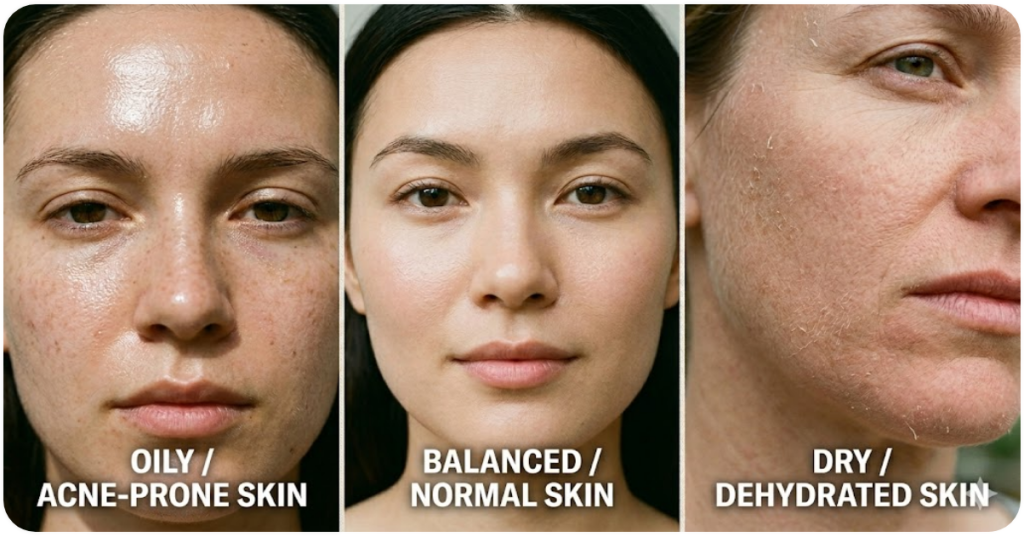
Before you can choose a product, you must be certain of your starting point. You can’t navigate if you don’t know your location. While a dermatologist can give you a professional analysis, you can get a very accurate idea at home with the simple “Wash-and-Wait” Method.
- Wash your face with a gentle, basic cleanser. Do not apply any other products.
- Wait 30 minutes without touching your face. Let your skin normalize.
- Analyze the results:
- Oily Skin: If you see shine all over your face and your skin feels greasy.
- Dry Skin: If your face feels tight, looks dull, or has flaky patches.
- Combination Skin: If your T-zone (forehead, nose, chin) is oily, but your cheeks are dry or normal.
- Sensitive Skin: If you notice redness, itching, or stinging.
Once you know your type, you are ready to find your hydrating moisturizer match.
Understanding Moisturizer Types (Lotion vs. Cream vs. Gel vs. Ointment) 🍦
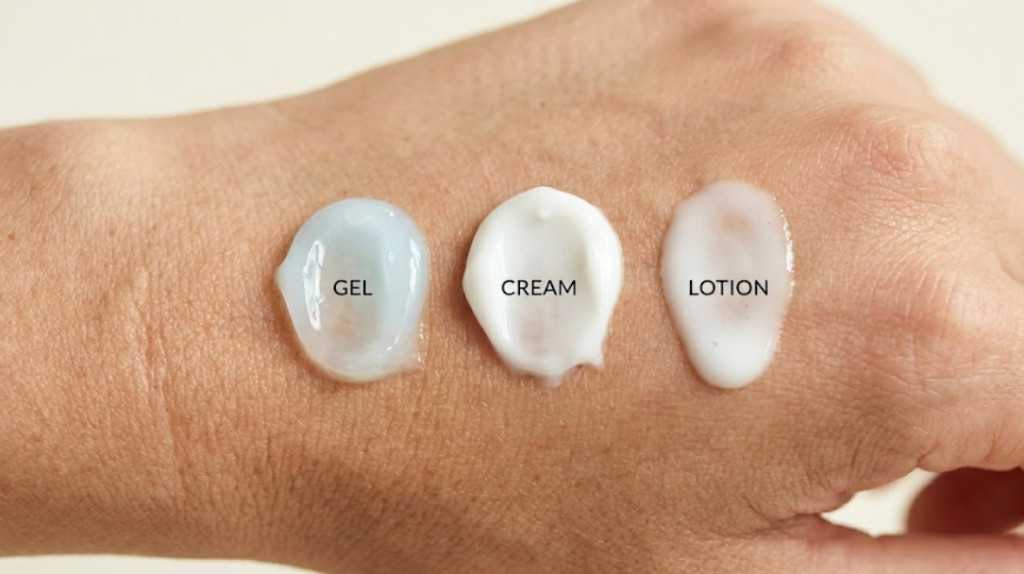
When you are in the moisturizer aisle, the texture of the product is your biggest clue. The terms aren’t interchangeable; they describe the product’s oil-to-water ratio. Understanding this ratio is rule #1 of how to know skin type matching.
- Ointment (Max Oil, Min Water): These are the thickest, greasy-feeling products (like petroleum jelly). They are not for daily facial use but are vital for extremely cracked, eczematous skin or for skin barrier repair on severe dry patches.
- Cream (High Oil, Moderate Water): Creams are rich and dense. They are the ideal choice for how to choose a moisturizer for dry skin. They are too heavy for oily skin but provide the deep, lasting hydration that dry skin craves.
- Lotion (Moderate Oil, High Water): Lotions are lightweight and spread easily. They are the “all-rounder” texture. They work well for normal skin or the drier areas of combination skin. They may not be hydrating enough for severe dryness.
- Gel (Zero/Minimal Oil, Max Water): Gels are typically clear or cloud-white and absorb almost instantly. This is the best moisturizer for oily skin as it hydrates without adding a drop of pore-clogging grease.
The 3 Key Ingredients You Must Understand 🧪
To truly master how to choose a moisturizer for your skin type, you need to look past the fancy branding and find the “Big Three.” Every effective moisturizer is a blend of these three ingredient categories.
- Humectants (The Water Magnets): These ingredients, like hyaluronic acid and glycerin, pull water into the top layer of your skin. Think of them as a drink of water for your cells.
- Emollients (The Smoothers): Ingredients like squalane or jojoba oil fill in the tiny gaps between your skin cells. They make your skin feel soft, flexible, and smooth to the touch.
- Occlusives (The Security Guards): These are heavier ingredients like petrolatum, shea butter, or beeswax. They create a physical seal on top of your skin to prevent transepidermal water loss (TEWL). Without them, all that hydration you just added would simply evaporate into the air. 💨
7 Simple Rules to Choose the Right Moisturizer 🏆
Now that you know the building blocks, use these seven rules as your checklist. This is the best moisturizer for skin type strategy used by professionals.
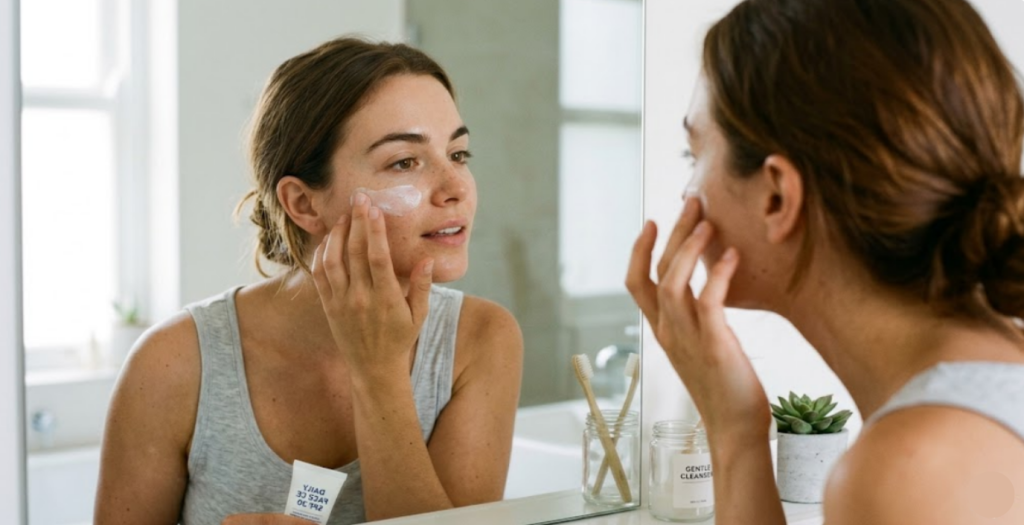
1. Match Texture to Your Skin Type
As a rule of thumb: the drier your skin, the thicker the product should be. If you have oily skin, a heavy cream will feel like a mask. If you have dry skin, a thin gel will leave you feeling tight within minutes. Respect the texture.
2. Look for Barrier-Repair Ingredients (Ceramides)
Regardless of your type, everyone needs a healthy skin barrier. Look for ceramides. These are lipids naturally found in your skin that help hold everything together. Using a moisturizer with ceramides is like giving your skin “reinforcements” to keep moisture in and irritants out. 🛡️
3. Avoid Fragrance if You Have Sensitive Skin
“Smelling like a rose” is great for a candle, but it is often a disaster for your face. Fragrance is the #1 cause of contact dermatitis in skincare. If you are prone to redness, always reach for “fragrance-free” (not just “unscented,” which can contain masking scents).
4. Choose Non-Comedogenic for Acne-Prone Skin
If you are worried about breakouts, this label is your best friend. A non-comedogenic moisturizer is specifically formulated to not clog your pores. It’s a must-have for the best moisturizer for oily and acne-prone skin.
5. Pick Lightweight Formulas for Oily Skin
Oily skin still needs moisture! If you skip it, your skin may over-produce oil to compensate. Stick to oil-free, water-based gels that provide “weightless” hydration.
6. Go Rich and Thick for Dry Skin
Dry skin lacks natural oils (sebum). You need a moisturizer that replaces those oils. Look for products containing shea butter, dimethicone, or mineral oil to provide that long-lasting, comfortable “cushion” your skin needs.
7. Adjust Based on Weather and Climate
Your skin type can change with the seasons. You might need a lightweight lotion in the humid summer and a heavy, occlusive cream in the bone-dry winter. Listen to your skin and be ready to swap your routine as the temperature drops. ❄️☀️
Best Moisturizer for Dry Skin 🏜️
When you are learning how to choose a moisturizer for dry skin, you have to think about “sealing.” Dry skin lacks natural lipids, which means your moisture barrier is like a leaky bucket. You can pour in all the water you want, but it won’t stay without a lid.
The best formulas for this type are thick creams and balms. Look for ingredients that provide a heavy-duty seal, such as shea butter, squalane, or petrolatum. These act as occlusives, sitting on the surface to ensure your hydration stays locked in all day. If your skin feels “ashy” or tight by lunchtime, your current moisturizer isn’t thick enough.
Best Moisturizer for Oily and Acne-Prone Skin 🌊
The most common myth in skincare is that oily skin doesn’t need moisture. In reality, if you skip the cream, your skin may panic and produce more oil to protect itself. The trick is finding the best moisturizer for oily and acne-prone skin that doesn’t feel like a heavy mask.
You should prioritize gel-based and “water-cream” textures. These are typically oil-free and rely on hyaluronic acid to hydrate without adding grease. Because you are prone to congestion, ensuring your product is labeled “non-comedogenic” is non-negotiable. You want hydration that sinks in immediately, leaving a matte or natural finish. 🕊️
Best Moisturizer for Sensitive Skin 🛡️
For those with reactive complexions, “less is more.” When looking for a sensitive skin moisturizer, the ingredient list should be your first stop. You want a formula that focuses on skin barrier repair without any “fluff.”
- The “No” List: Avoid denatured alcohol, essential oils, and synthetic fragrances. These are the most likely moisturizer ingredients to avoid for sensitive skin.
- The “Yes” List: Look for calming agents like allantoin, oat extract (colloidal oatmeal), or panthenol. These help lower the “temperature” of irritated skin and build back your natural defenses.
Can Moisturizer Cause Breakouts? 🌋
Many people abandon their hydrating moisturizer because they notice a pimple a few days after starting a new routine. But is the moisturizer always to blame?
Sometimes, yes—if you are using a moisturizer causing acne by being too heavy for your pore size. This is called “occlusion folliculitis.” However, it could also be a “purging” effect if the moisturizer contains active ingredients like AHAs or BHAs. To avoid this, always introduce one product at a time and give your skin two weeks to adjust. If you see deep, cystic bumps, the formula is likely too “occlusive” (smothering) for your specific skin type. 🛑
Expensive vs. Drugstore Moisturizers: Does It Matter? 💸
One of the most frequent questions in skincare is whether that $100 jar of “miracle broth” is actually better than a $15 drugstore tub. The honest truth? Your skin doesn’t have a price sensor. It only has receptors for ingredients.
Many drugstore brands are owned by the same parent companies as luxury brands. This means they often share the same patented skin barrier repair technology. While expensive creams might offer a more “elegant” texture or a prettier glass jar, the core work is often done by humble ingredients like glycerin and petrolatum. Unless you are paying for a very specific, rare active ingredient, a high-quality drugstore hydrating moisturizer will usually do the job just as well as the luxury version.
When and How to Apply Moisturizer ⏱️
Even the perfect moisturizer for skin type will fail if your timing is off. Most people wait until their skin is bone-dry before applying, but this is a missed opportunity.
The “Golden Rule” of application is to apply to damp skin. After you wash your face, pat it gently with a towel so it’s not dripping, then apply your moisturizer immediately. This allows the humectants in the formula to “trap” that surface water and pull it into your skin. For your nighttime routine, don’t be afraid to use a slightly thicker layer. Your skin works hardest at repair while you sleep, and a little extra “cushion” can prevent that morning tightness.
Moisturizer with SPF: Should You Use It? ☀️
It sounds like a dream: a “2-in-1” that hydrates and protects. However, moisturizer with SPF comes with a few caveats.
While these products are great for a quick morning routine, they often fall short of true protection. Because it’s a moisturizer first, you likely won’t apply the full “two-finger” amount required to get the SPF listed on the label. Furthermore, you should never use these at night. Your skin doesn’t need sun filters while you sleep, and those extra chemicals can lead to moisturizer causing acne if left on during your repair cycle. Use them for convenience, but keep a dedicated sunscreen handy for long days outdoors.
Common Moisturizer Mistakes People Make 🚩
Are you getting the most out of your product? Avoid these common moisturizer mistakes to ensure your skin stays healthy:
- Tugging the Skin: Never “rub” your cream in aggressively. Use gentle, upward circular motions to avoid breaking down your skin’s elasticity over time.
- Using Too Much: Your skin can only absorb so much. If the product is “pilling” or sitting on top of your face for hours, you’re using too much. A nickel-sized amount is usually plenty.
- Neglecting the Neck: Your neck and décolletage have fewer oil glands than your face, making them prone to aging faster. Always bring your hydrating moisturizer down past your jawline. 🦒
- Applying to Dirty Skin: Never “top off” your moisturizer during the day without cleansing first. You’re just trapping dirt and bacteria underneath a new layer of cream.
Honest Truth: More Moisturizer Doesn’t Mean Better Skin 🧘♂️
In the world of skincare marketing, we are taught that “more is more.” We think if our skin feels slightly dry, we should slather on ten layers of cream. But the honest truth is that your skin has a saturation point.
Over-moisturizing can actually lead to “lazy skin.” When you constantly coat the surface with heavy occlusives, your skin’s natural signaling process to produce its own lipids can slow down. This creates a cycle of dependency where your skin feels even drier the moment you stop using the product. The goal of knowing how to choose a moisturizer for your skin type is to find balance, not to suffocate your pores.
Simple Moisturizer Routine for Beginners 🚶♂️
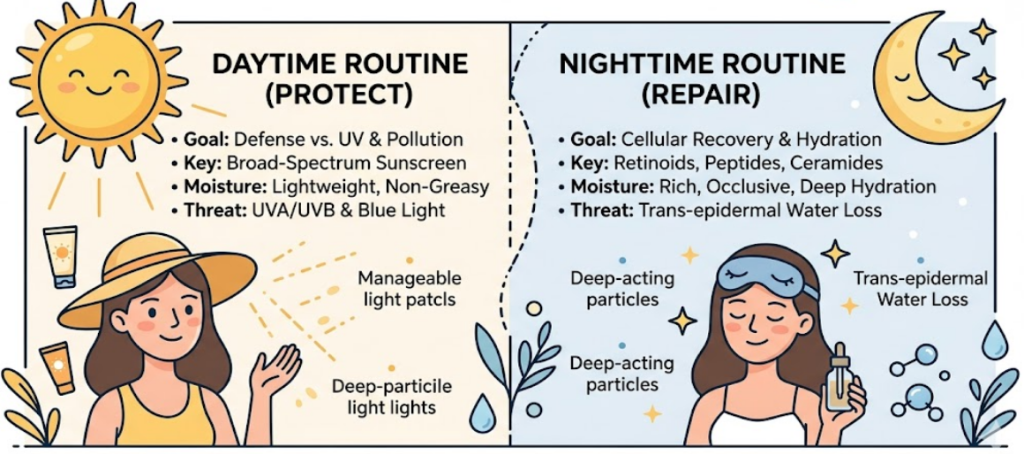
If you are just starting out, don’t overcomplicate it. A solid skincare routine moisturizer habit only needs two steps to be effective:
- Morning (Protect): Apply a lightweight, hydrating moisturizer to damp skin. If you use a moisturizer with SPF, this is the time for it. This layer acts as a buffer against environmental stressors throughout the day.
- Evening (Repair): After a deep cleanse, apply a slightly richer formula. Look for a non-comedogenic moisturizer with ceramides or fatty acids. This supports your skin’s natural regeneration process while you sleep.
That’s it. You don’t need a seven-step ritual to see results; you just need consistency and the right formula.
FAQs: Moisturizer Myths vs. Facts 🔍
Does oily skin need moisturizer?
Yes! Skipping it can cause “rebound oiliness,” where your skin produces even more sebum to compensate for the lack of surface hydration.
Should I use moisturizer every day?
Absolutely. Daily moisturization maintains the skin barrier repair process and prevents environmental damage from reaching deeper layers.
Can moisturizer clog pores?
Only if the formula is too heavy for your skin type or contains high levels of comedogenic oils (like coconut oil). Always look for “non-comedogenic” labels if you are acne-prone.
What is the difference between lotion and cream?
It’s all about the water-to-oil ratio. Lotions have more water and are lighter; creams have more oil and are thicker for deeper hydration. 🧴
Final Verdict: Choosing the Right Moisturizer Made Simple 🏁
At the end of the day, how to choose a moisturizer for your skin type comes down to one word: Intuition. Your skin is a living organ that changes with your hormones, the weather, and your stress levels. Don’t be afraid to have two different moisturizers—a lightweight gel for summer or oily days, and a richer cream for winter or dry spells. Listen to the “tightness” or the “shine” of your face, and adjust accordingly. Keep your ingredients simple, prioritize your barrier, and stop overpaying for fancy jars. Your skin will thank you with a healthy, natural glow. 🌟✨
References
- The Role of Moisturizers in Addressing Various Skin Conditions
- How Occlusives Prevent Moisture Loss
- The Role of Moisturizers in Addressing Various Kinds of Dermatitis: A Review
- Exploring Ingredients – Occlusives & Emollients