If you have ever stared into the mirror at a lingering acne scar or a new sun spot, you’ve likely been told that Vitamin C is the “holy grail” solution. It is the darling of the skincare world, featured in everything from $200 serums to drugstore cleansers.
But with all the hype comes a significant amount of confusion. Does vitamin C lighten dark spots, or is it just clever marketing? Is there a difference between “brightening” your complexion and “lightening” your skin tone? And perhaps most importantly, if those spots do fade, is the change permanent?
In this guide, we’re going to strip away the marketing jargon and look at the actual science. Whether you are dealing with stubborn melasma, post-acne marks (PIH), or age spots, here is the reality of what Vitamin C can—and cannot—do for your skin.
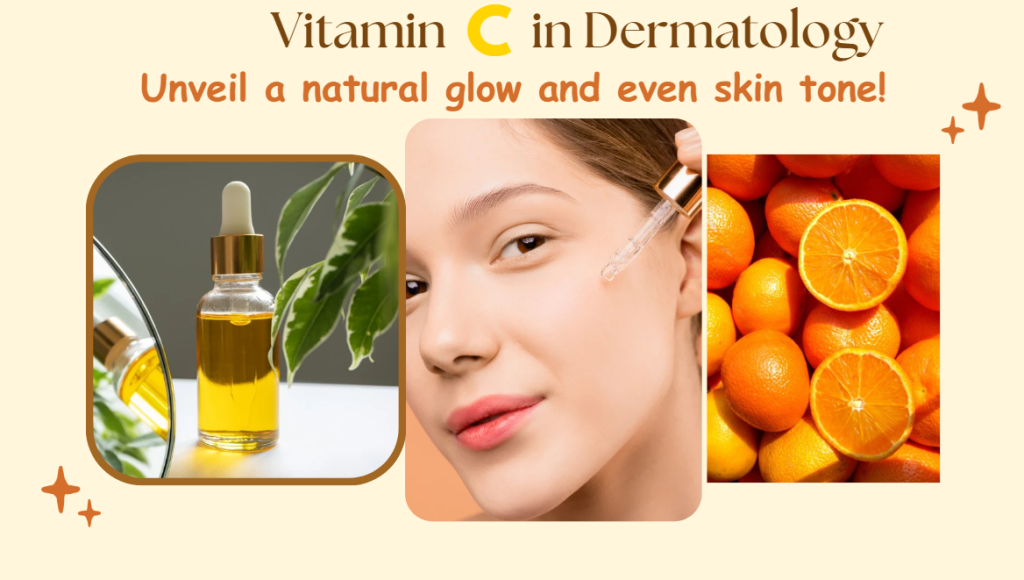
Does Vitamin C Lighten Dark Spots?
To give you the short answer: Yes, Vitamin C does lighten dark spots. However, it doesn’t work the way a bleach or a “whitening” agent does.
Vitamin C is technically a tyrosinase inhibitor. Tyrosinase is the enzyme in your skin responsible for producing melanin (pigment). When you apply a stable Vitamin C serum, it tells your skin to “turn down the volume” on pigment production.
The Key Takeaways:
- It’s a Fader, Not a Bleach: It targets overactive pigment cells (hyperpigmentation) without changing the color of your normal, healthy skin.
- It Takes Patience: This isn’t an overnight fix. Because it works by inhibiting future pigment, you have to wait for your current pigmented cells to naturally shed away—a process that usually takes 8 to 12 weeks.
- Consistency is Queen: Using it once in a while won’t yield results. It requires daily application to keep those pigment-producing enzymes in check.
How Does Vitamin C Lighten Skin?
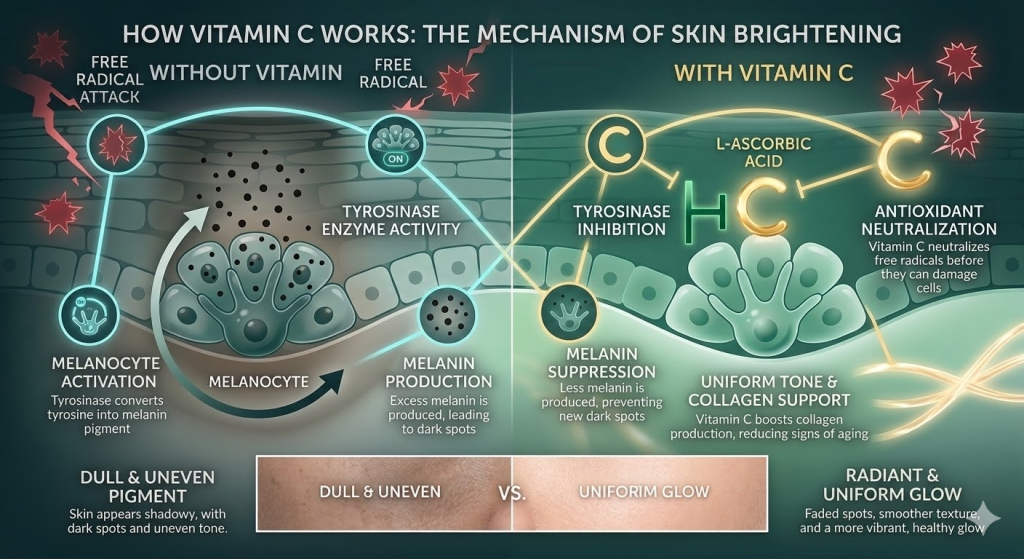
To understand how vitamin C lightens skin, we have to look at what’s happening beneath the surface. Think of your skin as a factory. When it gets “injured”—by UV rays or an inflamed pimple—the “Melanin Department” goes into overdrive to protect the area, creating a dark spot.
Vitamin C intervenes in three specific ways:
- The Off Switch (Enzyme Inhibition): As mentioned, it blocks tyrosinase. By stopping the enzyme before it can create melanin, Vitamin C prevents the dark spot from getting darker.
- The Shield (Antioxidant Action): Dark spots are often darkened further by “oxidative stress” (free radicals from the sun and pollution). Vitamin C neutralizes these invisible aggressors, acting like an internal parasol for your cells.
- The Cleanup Crew (Cell Turnover): While not an exfoliant like glycolic acid, Vitamin C supports healthy cell regeneration. By protecting the skin’s structure, it helps the surface appear more uniform and light-reflective.
Does Vitamin C Lighten Skin or Just Brighten It?
This is the most common point of confusion. In the world of skincare, “lightening” and “brightening” are two very different things.
- Brightening is about radiance. It’s the “glow” you get when your skin is healthy, hydrated, and reflecting light evenly. Vitamin C excels at this because it smooths the skin surface and fights dullness.
- Lightening (in the context of spots) refers to reducing the intensity of excess pigment. Vitamin C does this by fading hyperpigmentation back to your natural skin tone.
Does vitamin C lighten your skin beyond your natural shade? No. It cannot—and should not—change your genetic skin tone. It simply helps your skin return to its “baseline” by removing the “extra” pigment caused by sun, age, or scarring.
Does Vitamin C Lighten Skin Tone Permanently?
One of the most searched questions is: Does vitamin C lighten skin permanently? The honest answer is no. Skincare results are rarely permanent because your skin is a living, breathing organ that is constantly reacting to its environment.
Why Dark Spots Come Back:
- The Sun Factor: You can use the most expensive Vitamin C in the world, but five minutes of unprotected sun exposure can “re-trigger” those pigment cells. The UV rays tell the “Melanin Department” to start production again.
- Maintenance: Once you stop using Vitamin C, you lose that daily inhibition of tyrosinase. If your skin is prone to hyperpigmentation, the spots may slowly begin to reappear over time.
- The “Memory” of Cells: Conditions like melasma have a “memory.” The cells in those areas are hypersensitive and will produce extra pigment at the slightest hint of heat or light.
Think of Vitamin C like exercise: you don’t stay fit forever after one month at the gym. You have to maintain the routine to maintain the results.
In this next installment, we move from the general “how-it-works” to the specific “will-it-work-for-me.” We explore how Vitamin C interacts with different types of scarring and, crucially, how it performs on melanated skin.
Does Vitamin C Lighten Acne Scars?
If you have ever dealt with a breakout, you know that the “ghost of the pimple” (the dark mark left behind) often lasts much longer than the blemish itself. But does vitamin C lighten acne scars effectively?
To answer this, we have to distinguish between two types of marks:
- Post-Inflammatory Hyperpigmentation (PIH): These are the flat, brown or black marks left after a pimple heals. Vitamin C is highly effective here because it inhibits the melanin that causes these spots.
- Atrophic or Hypertrophic Scars: These are textural changes, like “ice pick” scars or raised bumps. Because these involve deep structural damage to the dermis, Vitamin C alone cannot “fill in” or flatten them. However, because Vitamin C is a co-factor in collagen synthesis, it can help improve the overall texture and speed of the skin’s healing process.
Does Vitamin C Lighten Sun Spots & Freckles?
Sun spots (solar lentigines) and freckles are the skin’s “memory” of UV exposure. While they may look similar, their response to treatment varies.
- Sun Spots: These are clusters of melanin caused by years of sun exposure. Does vitamin C lighten sun spots? Yes, but they are often deeper than acne marks, meaning you may need a higher concentration (15-20%) of L-ascorbic acid and a minimum of 3 months of consistent use to see a visible change.
- Freckles: Freckles are often genetic. While Vitamin C can prevent them from getting darker during the summer months, it generally will not “erase” genetic freckles. It simply keeps the skin’s overall tone more uniform.
Does Vitamin C Lighten Dark Circles?
The “raccoon eye” look is a top concern for many, but the answer to does vitamin C lighten dark circles depends entirely on why the circles are there.
- Pigmented Circles: If your dark circles are caused by sun damage or genetics (common in deeper skin tones), Vitamin C can help fade that pigment.
- Vascular Circles: If your circles look blue or purple, it’s likely due to thin skin showing the blood vessels underneath. Vitamin C helps here by thickening the dermis through collagen production, making the vessels less visible.
- Shadowed Circles: If your “dark circles” are actually hollows caused by fat loss (tear troughs), topical Vitamin C will not fix the shadow.
Vitamin C for Hyperpigmentation in Dark Skin
For a long time, the skincare industry focused its Vitamin C research on lighter skin tones. However, vitamin C for hyperpigmentation in dark skin (Fitzpatrick scales IV–VI) is actually one of the most effective tools available—provided it is used correctly.
Key Considerations for Deep Skin Tones:
- The “Rebound” Risk: Dark skin is highly reactive. If a Vitamin C serum is too acidic (very low pH) or too concentrated, it can cause irritation. In dark skin, irritation can actually trigger more hyperpigmentation.
- The Gentle Approach: If you have sensitive, melanated skin, look for “Vitamin C derivatives” like Sodium Ascorbyl Phosphate or THD Ascorbate. These are more stable and less likely to cause the stinging that leads to dark marks.
- The Synergy: Vitamin C works best on dark skin when paired with Niacinamide or Tranexamic Acid, creating a multi-pathway attack on stubborn pigment.
Vitamin C for Skin Whitening: Marketing vs. Reality
We must address the elephant in the room: the search for vitamin C for skin whitening. In many cultures, “whitening” is a common term, but in dermatology, we prefer “brightening” or “evening.”
The Reality Check:
- Vitamin C is NOT a Bleach: It does not contain harsh chemicals like hydroquinone or mercury. It cannot change your skin from a deep tone to a light tone.
- Focus on Clarity: When people see results from Vitamin C and call it “whitening,” what they are actually seeing is the removal of a “dullness veil” and the fading of uneven brown spots.
- Ethical Skincare: High-quality Vitamin C should be used to achieve skin health and uniformity, not to alter your natural identity. It’s about making your natural skin tone the most radiant version of itself.
How to Use Vitamin C Tablets for Skin Whitening
The internet is full of “hacks” suggesting you can crush up Vitamin C supplements to create a mask. If you are searching for how to use vitamin C tablets for skin whitening, the short answer is: Please don’t.
While the intent is to save money, DIY Vitamin C masks are often ineffective or even harmful:
- pH Imbalance: Pure Vitamin C (Ascorbic Acid) is highly acidic. Formulated serums are carefully balanced to a pH of about 3.5 to ensure penetration without burning. A crushed tablet has no such balance and can cause a chemical burn on your face.
- Stability: Vitamin C is notoriously unstable. The moment a tablet is crushed and exposed to air and water, it begins to oxidize. By the time you apply it, the active “lightening” power is likely gone.
- Oral vs. Topical: While taking Vitamin C supplements is great for overall health, only a tiny fraction of what you eat actually reaches your skin cells. To fade dark spots, topical application via a stabilized serum is significantly more effective.
Best Vitamin C for Pigmentation: A Buying Guide
Not all Vitamin C is created equal. If you want the best vitamin C for pigmentation, you need to look past the fancy packaging and read the ingredient list for these three power players:
- L-Ascorbic Acid (L-AA): The gold standard. It is the most researched and potent form. Look for a concentration between 10% and 20%. Anything less is ineffective for deep spots; anything more is too irritating.
- THD Ascorbate: An oil-soluble version that is becoming a favorite for sensitive and dark skin. It penetrates deeper and is much more stable than L-AA.
- Sodium Ascorbyl Phosphate (SAP): A gentler derivative that is also excellent for those who deal with both acne and dark spots simultaneously.
The Packaging Rule: Vitamin C’s worst enemies are light and air. Only buy serums in dark, opaque, or amber bottles with airtight pumps. If the serum looks dark orange or brown when you open it, it has oxidized and will no longer lighten your spots.
How Long Does Vitamin C Take to Fade Dark Spots?
One of the main reasons people give up on Vitamin C is unrealistic expectations. Your skin cells take roughly 28 to 40 days to “turn over.” To see the fading of a dark spot, you have to wait for the old, pigmented cells to move to the surface and shed.
The Longevity Timeline:
- Weeks 1-4: You’ll notice a “glow.” This is the antioxidant effect reducing dullness.
- Weeks 4-8: The edges of dark spots may begin to soften. Your overall skin tone will look more “rested.”
- Weeks 8-12: This is the “sweet spot.” Visible fading of acne scars and sun spots usually happens during this window.
- Beyond 12 Weeks: Maximum results for deep-seated hyperpigmentation.
Mistakes That Stop Vitamin C From Working
If you’ve been using a serum for months with no change, you might be making one of these common mistakes:
- Skipping Sunscreen: This is the biggest error. Vitamin C stops melanin, but the sun triggers it. If you don’t wear SPF 30+ daily, you are essentially trying to “mop the floor while the faucet is still running.”
- Mixing with the Wrong Ingredients: Avoid using Vitamin C at the exact same time as Benzoyl Peroxide (which oxidizes the C) or high-strength AHAs/BHAs (which can cause irritation that leads to more spots).
- Storing it in the Bathroom: The heat and humidity of a bathroom accelerate oxidation. Keep your bottle in a cool, dark drawer (or even a skincare fridge).
Who Should NOT Use Vitamin C?
While it is a superstar ingredient, it isn’t for everyone. You should proceed with caution or look for alternatives if:
- You have active Rosacea: The acidity of L-Ascorbic acid can trigger a flare-up.
- You have extremely sensitive/eczema-prone skin: The low pH required for Vitamin C can be too disruptive to a compromised skin barrier.
- Alternatives to Consider: If Vitamin C isn’t a match, look for Azelaic Acid or Tranexamic Acid. These are equally powerful for fading dark spots but are often much gentler on reactive skin.
In this final section, we bring everything together into a clear, actionable verdict. We’ll summarize the “should-you-or-should-you-not” framework and provide the high-value snippet answers Google’s “People Also Ask” algorithm craves.
Final Verdict: Should You Use Vitamin C for Dark Spots?
The evidence is clear: Vitamin C is one of the most effective, science-backed tools for addressing hyperpigmentation. However, its success depends entirely on your expectations and your discipline.
If your goal is to achieve a more uniform, radiant complexion and fade the “reminders” of past breakouts or sun damage, Vitamin C should be a cornerstone of your routine. But remember: it is a brightener, not a bleach. It works with your skin’s natural biology to restore its original clarity.
To get the best results:
- Pair it with SPF: Without sunscreen, Vitamin C is a waste of money.
- Be Patient: Give it at least 90 days of daily use.
- Check the Color: If your serum turns a dark “maple syrup” brown, it’s time to toss it.
Final Thought: Think Fading, Not Bleaching
The journey to an even skin tone is a marathon, not a sprint. Vitamin C is your most reliable running partner. By protecting your cells from the “inside out” and quieting the overactive pigment factory, it helps you achieve a clarity that looks healthy, natural, and—most importantly—luminous.
❓ FAQ Section
Does vitamin C lighten dark spots permanently?
No. While Vitamin C effectively fades existing spots by inhibiting melanin production, the results are not permanent if you are exposed to UV rays without protection. Sun exposure can re-trigger pigment cells, causing spots to return. Constant use and daily sunscreen are required for lasting results.
How long does vitamin C take to lighten dark spots?
Most users see an initial “glow” within 2 to 4 weeks. However, significant fading of dark spots typically requires 8 to 12 weeks of consistent daily application, as this aligns with the natural cycle of skin cell turnover.
Can vitamin C change your natural skin color?
No. Vitamin C is not a skin-bleaching agent. It only inhibits the excess melanin produced by damage (like sun or acne). It will return your skin to its natural, baseline tone but cannot lighten your skin beyond its genetic color.
Is vitamin C safe for dark skin?
Yes, Vitamin C is excellent for dark skin, which is often prone to post-inflammatory hyperpigmentation (PIH). To avoid irritation, those with deeper skin tones should opt for stable derivatives like THD Ascorbate or Sodium Ascorbyl Phosphate.
Can I use vitamin C every day?
Yes. For most skin types, Vitamin C is best used once daily in the morning to take advantage of its antioxidant protection against daytime pollution and UV rays.
Does oral vitamin C lighten skin?
Oral Vitamin C is vital for overall health and collagen synthesis, but topical serums are much more effective for targeted spot-fading. Only a small percentage of ingested Vitamin C reaches the skin’s surface in a high enough concentration to inhibit pigment.
🧪 References & Clinical Sources
- Topical Vitamin C and the Skin (Journal of Clinical and Aesthetic Dermatology) – A comprehensive look at how Vitamin C works as an antioxidant and anti-pigmentation agent.
- Vitamin C (5%) vs. Hydroquinone (4%) in Melasma Treatment – A summary of a landmark double-blind study showing that Vitamin C is a safe, effective alternative to harsh bleaching agents.
- Vitamin C as an Inhibitor of Tyrosinase (PMC) – The biological data explaining how Vitamin C “shuts off” the pigment-producing enzyme.
- Vitamin C in Dermatology (Indian Dermatology Online Journal) – A deep dive into the stability of different Vitamin C forms (L-ascorbic acid vs. derivatives).
- https://pmc.ncbi.nlm.nih.gov/articles/PMC7802860/#:~:text=Under%20physiological%20conditions%2C%20Vitamin%20C,its%20direct%20effect%20on%20melanogenesis.