
Many health-conscious drinkers make the switch to decaf specifically to escape the cycle of jitters, anxiety, and late-night ceiling-staring. We’ve been told that removing the caffeine removes the stress, but a nagging question remains for many: does decaf coffee raise cortisol anyway?
It’s a frustrating experience—you swap your standard brew for a decaffeinated version, yet you still feel that familiar “wired” sensation or a subtle spike in your heart rate. Is it all in your head, or is there a biological mechanism at play that transcends the caffeine molecule? As we dive into the relationship between the bean and the HPA axis, we’ll discover that while decaf is a massive improvement for stress management, it isn’t always a “blank slate” for your hormones.

Does Decaf Coffee Raise Cortisol? ⚡
In most people, decaf coffee has a minimal impact on cortisol levels compared to regular coffee. However, decaf is not 100% caffeine-free; it contains trace amounts (2–5 mg) that can affect highly sensitive individuals. Furthermore, factors like the “conditioned response” (where your brain associates the taste of coffee with a boost) and the timing of your cup can still trigger a mild hormonal response. While it won’t cause the massive cortisol spike of a double espresso, decaf can still influence your system in subtle, surprising ways.
What Is Cortisol and Why It Matters 🧬
Before we can answer does decaf coffee affect cortisol, we have to understand what this hormone actually does. Cortisol is often unfairly labeled as the “bad” hormone, but it’s actually essential for life. It regulates your metabolism, reduces inflammation, and controls your sleep-wake cycle.
One of its most important roles is the Cortisol Awakening Response (CAR). Every morning, your body naturally spikes cortisol to help you wake up and face the day. Problems only arise when we layer external stimulants—like high-dose caffeine—on top of this natural peak. This “double-spiking” can lead to a crashed HPA axis and long-term fatigue. Decaf is often seen as a way to respect this natural rhythm without the artificial “shove” of a stimulant.

Does Decaf Coffee Actually Raise Cortisol? 🔬
This is the core of our investigation: does decaf coffee raise cortisol levels like regular coffee? Clinical studies consistently show a dramatic difference between the two.
When you drink regular coffee, the caffeine quickly crosses the blood-brain barrier and signals the pituitary gland to tell the adrenal glands to pump out cortisol and adrenaline. With decaf, this primary “trigger” is largely absent. Most research indicates that for the average person, the hormonal spike from decaf is statistically insignificant. However, “average” doesn’t mean “everyone.” For those with extreme caffeine sensitivity or compromised adrenal health, even the tiny amount of stimulant left in decaf can be enough to nudge the needle.
How Much Caffeine Is Really in Decaf Coffee? ☕️🔍
One of the most common digestion myths (and coffee myths) is that decaf means “zero caffeine.” Under US FDA regulations, coffee must have 97% of its caffeine removed to be labeled decaf.
- The Math: A typical 8 oz cup of regular coffee has 95–150 mg of caffeine.
- The Reality: A cup of decaf usually contains between 2 mg and 5 mg.
- The Accumulation Effect: If you drink five or six cups of decaf throughout the day, you may consume 20–30 mg of caffeine.
While this is still lower than a single regular cup, it is enough to trigger a physiological response in someone who is “caffeine-naive” or particularly sensitive. If you’re wondering why does decaf coffee make me feel anxious, the answer might lie in these hidden milligrams.
Why Some People Still Feel “Stimulated” After Decaf 🧠⚡
Have you ever taken a sip of decaf and felt an almost instant wave of alertness? If you’re asking, “why does decaf coffee make me feel anxious?” or stimulated, the answer might be psychological rather than purely chemical.
This is known as a conditioned response. For years, your brain has associated the smell, warmth, and bitter taste of coffee with a massive hit of caffeine. When you drink decaf, your brain recognizes these sensory triggers and preemptively signals the HPA axis to prepare for a boost. In essence, your mind “tricks” your body into a mild cortisol spike simply because it expects one. This habit loop is so powerful that the ritual of the cup can be just as stimulating as the drug itself for long-time drinkers.
Decaf vs. Regular Coffee: Cortisol Impact Compared ⚖️
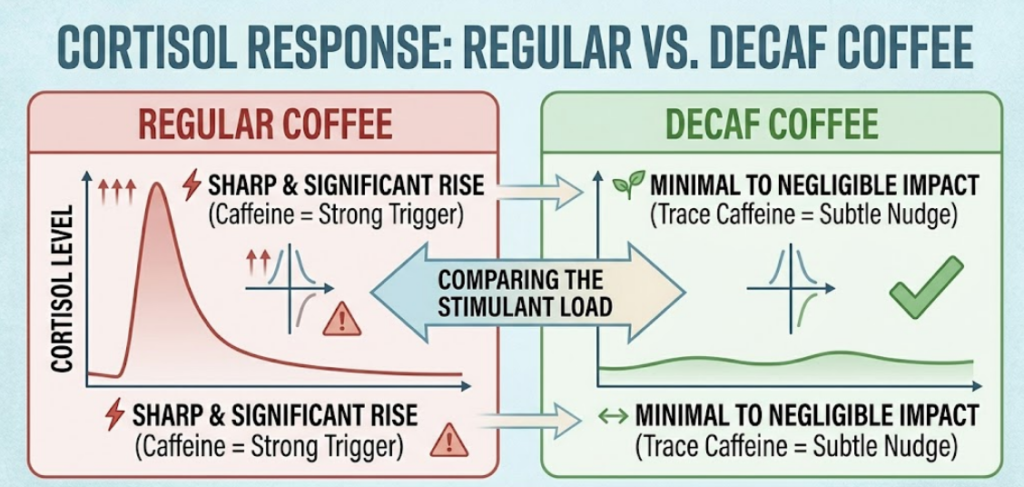
To get a clear picture of the hormonal landscape, it helps to compare the two side-by-side. While both come from the same bean, their impact on your stress hormones is worlds apart.
| Feature | Regular Coffee | Decaf Coffee |
| Caffeine Content | 95–150 mg per cup | 2–5 mg per cup |
| Cortisol Spike | Immediate and significant | Minimal to negligible |
| Adrenal Impact | High (can lead to “crash”) | Very Low |
| HPA Axis Trigger | Primary (Chemical) | Secondary (Psychological/Trace) |
For those trying to heal from chronic stress, switching to decaf represents a 95% reduction in the chemical “load” placed on the adrenal glands.
Can Decaf Coffee Affect the HPA Axis or Adrenal Health? 🏥
When discussing decaf coffee adrenal health, the conversation often turns to the “Hypothalamic-Pituitary-Adrenal” (HPA) axis. This is your body’s central command for stress.
Regular caffeine consumption keeps the HPA axis in a state of high alert, which can eventually lead to what many call “adrenal fatigue” (clinically known as HPA axis dysregulation). Because decaf lacks the high-octane stimulant, it allows the HPA axis to reset to its natural rhythm. However, it is not a “cure-all.” If you are already in a state of severe burnout, even the trace caffeine in decaf might be enough to keep your system from fully entering “rest and digest” mode.
Best Time to Drink Decaf Coffee for Hormonal Balance ⌚
If you want to protect your hormonal rhythm, timing is everything. Even with decaf, your body’s natural clock matters.
- Avoid the “Cortisol Peak”: Your natural cortisol is highest between 8:00 AM and 9:00 AM. Adding even a mild stimulant during this window can interfere with your body’s natural wake-up signal.
- The “Sweet Spot”: The best time to drink decaf coffee is usually between 10:00 AM and 12:00 PM, when your natural cortisol levels begin to dip.
- The Afternoon Cutoff: While decaf is low in caffeine, sensitive individuals should still avoid it after 2:00 PM. Those 5 mg of caffeine can have a half-life that lingers long enough to disrupt your deep sleep cycles.
Can Decaf Coffee Still Affect Sleep or Anxiety? 🌙
The short answer is: yes, for the right person.
If you are highly sensitive, the trace amounts in decaf can absolutely influence decaf coffee and stress hormones. Caffeine works by blocking adenosine receptors—the “sleepiness” molecules in your brain. Even a tiny amount of caffeine can occupy enough receptors to make falling asleep difficult for the ultra-sensitive. If you find that you are still jittery or wide-awake after a late-night decaf, your body is likely telling you that it requires a 100% caffeine-free environment, such as herbal tea.
Does the Way Coffee Is Decaffeinated Matter? 🧪
Not all decaf is created equal, and the method used to strip the caffeine can affect the final profile of bioactive compounds. If you are concerned about decaf coffee and stress hormones, the process matters.
- Swiss Water Process: This is a chemical-free, organic method that uses only water, temperature, and time to remove 99.9% of caffeine. It is often the preferred choice for health-conscious drinkers because it preserves the polyphenols—beneficial antioxidants—without introducing solvent residues.
- CO₂ Extraction: A natural method that uses pressurized carbon dioxide to pull out caffeine. It is highly effective and leaves no chemical footprint.
- Solvent-Based Methods: These use chemicals like ethyl acetate or methylene chloride. While the FDA deems them safe, some purists worry about the impact of trace residues on long-term adrenal health.
Choosing a high-quality process ensures you aren’t trading caffeine for chemical stressors that could indirectly impact your HPA axis.
Can Drinking Decaf on an Empty Stomach Affect Cortisol? 🍳
One of the most common habits is reaching for coffee the moment your eyes open. However, if you’re asking, “can decaf coffee trigger a cortisol response?”, the state of your stomach is a major factor.
When you drink coffee (even decaf) on an empty stomach, you risk a steeper rise in blood sugar and a sharper cortisol response. This is because your body is already in a fasted state, and the acidity and trace stimulants of coffee can signal a “stress” event to the gut. To keep your hormones stable, try the “Food First” rule: eat a small breakfast with protein and healthy fats before your coffee. This provides a buffer that slows down the absorption of trace caffeine and protects your gastric lining.
Common Mistakes That May Increase Cortisol Response ❌
Even with decaf, you can accidentally sabotage your hormonal rhythm. Avoid these frequent pitfalls:
- Overconsumption: Thinking “it’s just decaf” and drinking 6+ cups a day. This allows trace caffeine to accumulate to levels that mimic a regular cup of coffee.
- Ignoring Personal Sensitivity: Pushing through jitters because “it’s supposed to be decaf.” Listen to your body’s unique signal.
- Drinking Late into the Evening: Even 2 mg of caffeine can disrupt the architecture of your sleep, preventing the deep recovery your adrenal glands need.
- Using High-Sugar Creamers: Spiking your decaf with sugar causes an insulin surge, which is almost always followed by a cortisol surge to stabilize your blood sugar.
What the Evidence Supports vs. What’s Often Overstated ⚖️
To maintain conversion-focused trust, we have to separate clinical facts from wellness exaggerations regarding does decaf coffee raise cortisol.
What Evidence Supports
- Trace Caffeine Presence: Decaf is rarely 100% caffeine-free.
- Lower Stimulant Load: Decaf significantly reduces the burden on the HPA axis compared to regular coffee.
- Individual Variability: Genetic factors determine how fast you clear even tiny amounts of caffeine.
Claims That May Be Overstated
- “Decaf Causes Adrenal Fatigue”: There is no evidence that decaf alone can cause HPA axis dysregulation in a healthy person.
- “Decaf Is Completely Safe for Everyone”: Those with severe anxiety or insomnia may still need to avoid it entirely.
- “The Decaf Ritual Is the Same as the Drug”: While the conditioned response is real, it is far less taxing on the body than the actual chemical hit of 150 mg of caffeine.
Who Should Be Most Careful With Decaf Coffee? ⚠️
While most people thrive on the switch, certain groups should monitor their cortisol levels and anxiety closely:
- The “Slow Metabolizers”: People with the CYP1A2 gene variation clear caffeine very slowly. For them, even 5 mg can feel like 50 mg.
- Individuals with Panic Disorders: If your nervous system is already highly sensitized, the “ritual” and trace caffeine can act as a trigger.
- Those with Chronic Insomnia: If your sleep-wake cycle is broken, any stimulant—no matter how small—is a potential disruptor.
Expert Tips to Enjoy Coffee Without Raising Cortisol 🚀
If you want to keep your HPA axis calm while enjoying your favorite ritual, follow these professional strategies:
- Time Your Intake: Wait at least 90 minutes after waking up before having your first cup to allow your natural cortisol awakening response to settle.
- Eat Before You Sip: Always pair your decaf with a meal containing protein or healthy fats to prevent a sharp blood sugar or stress response.
- Quality Over Quantity: Opt for Swiss Water Process or CO₂ extracted beans to ensure you are getting the highest antioxidant profile with the lowest chemical stress.
- Listen to Your “Body Budget”: If you feel jittery even after decaf, consider switching to mineral-rich herbal alternatives like roasted dandelion root or chicory.
FAQs 🔍
Does decaf coffee raise cortisol levels?
For the vast majority of people, decaf has a negligible effect on cortisol. However, the trace caffeine (2–5 mg) and the psychological “habit loop” can trigger a mild response in sensitive individuals.
Why does decaf coffee still make me anxious?
This is often due to a conditioned response where your brain associates the taste and smell of coffee with a caffeine hit, or extreme sensitivity to the small amounts of caffeine still present.
Is decaf completely caffeine-free?
No. Most decaf coffee still contains about 3% of its original caffeine content.
Can decaf coffee affect sleep?
Yes. If you are a “slow metabolizer,” even the small amount of caffeine in a late-afternoon decaf can interfere with your ability to fall into a deep, restorative sleep.
Is decaf better for adrenal health?
Absolutely. Switching to decaf is one of the most effective ways to reduce the constant chemical “shoving” of your adrenal glands, allowing your stress response system to recover.
Final Verdict: The Truth About Decaf and Stress 🏁
So, does decaf coffee raise cortisol? The science tells us that while it isn’t a perfectly inert substance, it is a powerful tool for anyone looking to reclaim their hormonal balance. For most, the minor trace caffeine and the psychological “coffee ritual” effect are a small price to pay for the massive reduction in total stimulant load.
If you are struggling with chronic stress, anxiety, or burnout, moving to high-quality decaf is a strategic win. It allows you to keep the comfort of the ritual without the physiological price tag of a high-dose stimulant. Monitor your own sensitivity, time your cups wisely, and enjoy the peace of mind that comes with a calmer HPA axis.
References
- Caffeine Stimulation of Cortisol Secretion Across the Waking Hours in Relation to Caffeine Intake Levels
- Decaf Deep Dive: U.S. vs EU Standards and Why the Numbers Can Be Misleading
- Determining the Levels of Cortisol, Testosterone, Lactic Acid and Anaerobic Performance in Athletes Using Various Forms of Coffee