SALT LAKE CITY — For decades, Chronic Traumatic Encephalopathy (CTE) has loomed over contact sports and military service as an untreatable, inevitable shadow. But a wave of new research is offering a glimmer of hope, suggesting that something as simple as light might help the brain defend itself against the darkness of neurodegeneration.
New findings from University of Utah Health indicate that photobiomodulation—commonly known as red light therapy—may protect the brain from the inflammatory damage that drives CTE. While researchers urge caution, the results are sparking optimism in a field desperate for preventative solutions.
The Silent Threat: What is CTE?
Chronic Traumatic Encephalopathy (CTE) is a progressive degenerative disease of the brain found in people with a history of repetitive brain trauma. While often associated with concussions, researchers now believe it is driven largely by sub-concussive hits—the smaller, routine impacts sustained by linemen in football, soldiers in training, or boxers in sparring.
Over time, these impacts trigger a buildup of an abnormal protein called tau, which clumps together and slowly kills brain cells. The consequences are devastating: memory loss, confusion, impaired judgment, impulse control problems, aggression, depression, and eventually, progressive dementia. Currently, CTE can only be definitively diagnosed after death, and there is no known cure.
A “Shield” of Light: The University of Utah Study
In a potentially ground-breaking study published in the Journal of Neurotrauma, researchers at University of Utah Health tested whether red light therapy could intervene in this degenerative process before it takes hold.
The study followed 26 collegiate football players through a 16-week competitive season. Half the players administered a self-treatment three times a week using a specialized headset and nasal clip that emitted near-infrared light. The other half used a placebo device that looked identical but emitted no therapeutic light.
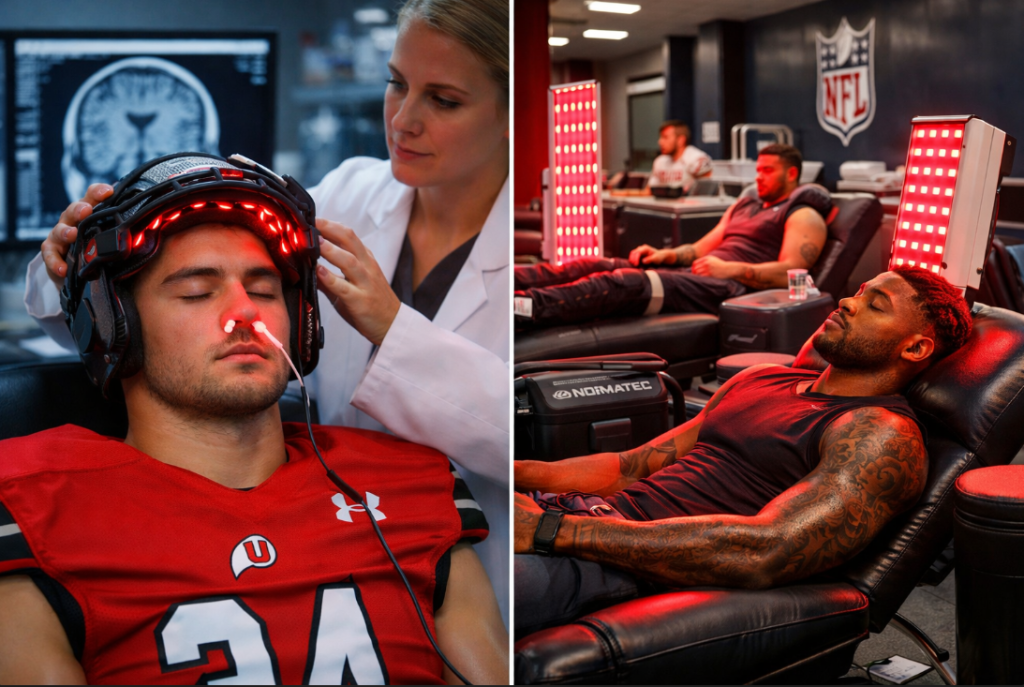
The results were stark. By the end of the season, players in the placebo group showed a significant increase in neuroinflammation markers on their brain scans—a typical response to a season of head impacts. However, the players who received the red light therapy showed no increase in inflammation.
“When we first started this project, I was extremely skeptical,” said Elisabeth Wilde, PhD, professor of neurology at U of U Health and senior author of the study. “But we’ve seen consistent results across multiple of our studies, so it’s starting to be quite compelling.”
How It Works: The Science of Photobiomodulation
The science behind the therapy, known as photobiomodulation (PBM), centers on mitochondria—the power plants of the cell.
“Red and near-infrared light have wavelengths that can penetrate the skull and reach the brain tissue,” explains Dr. Wilde. Once there, the light energy is absorbed by cytochrome c oxidase, an enzyme within the mitochondria.
This interaction boosts the production of ATP (cellular energy) and triggers the release of nitric oxide, which improves blood flow and reduces oxidative stress. Essentially, the light appears to give brain cells a “metabolic boost,” allowing them to repair minor damage and clear out inflammatory waste products more efficiently than they could on their own.
From Lab to Locker Room: The Rise of Recovery Tech
While clinical trials are still in early stages, the sports performance industry is already moving fast. Professional athletes and recovery facilities are increasingly adopting “recovery tech” that integrates these principles.
Companies like Solbasium are at the forefront of this shift, outfitting NFL players and high-performance gyms with full-body red light therapy beds. As reported by Muscle & Fitness, facilities like the Solbasium Helios bed are marketed not just for muscle recovery, but for systemic resilience—helping athletes “bounce back” faster from the physical toll of the game.
“We are seeing a shift where recovery is no longer just about ice baths and stretching,” notes the report. “Technologies that target cellular repair, like red light therapy, are becoming standard in the pros because they address the internal wear and tear that creates long-term vulnerability.”
The Road Ahead: DoD Funds Major Trial
Despite the excitement, the medical community remains cautious. Experts emphasize that the Utah study was small, and while the data is promising, it is not yet proof of a cure.
To bridge the gap between “promising” and “proven,” the Department of Defense (DoD) has stepped in. Recognizing the massive implications for soldiers exposed to blast waves and combat training, the DoD is funding a much larger, multi-site clinical trial.
Slated to begin recruitment early this year, this new trial will enroll 300 participants, including veterans, active-duty service members, and first responders suffering from persistent symptoms of traumatic brain injury (TBI). This rigorous study aims to validate whether the neuroprotective effects seen in college athletes translate to broader populations with more established brain injuries.
Implications for the Future
If validated, these therapies could fundamentally change how contact sports are played and how military personnel are treated. Instead of waiting for symptoms to appear years later, athletes and soldiers could potentially use light therapy as a “prophylactic” measure—a daily shield for brain health.
However, specialists warn against viewing this as a license to ignore safety.
“We cannot let technology become an excuse to take more risks,” warns a leading neurologist involved in CTE research. “Red light might help the brain repair, but it doesn’t make the brain invincible. Reducing head impacts is still the only 100% effective prevention strategy. But for those who serve or play, this could be the difference between a healthy life and a tragic decline.”
As the DoD trials commence, the world watches with bated breath. For the first time in the fight against CTE, we may be looking at a future that is quite literally a little bit brighter.