You are standing in the skincare aisle, staring at a wall of brightly colored bottles. They all promise the same thing: “Maximum Protection,” “SPF 50,” and “Dermatologist Tested.” It’s tempting to grab the one with the prettiest packaging and head to the checkout. However, beneath the surface, there is a fundamental divide in how these products work.
Choosing between mineral vs chemical sunscreen isn’t just about brand preference; it’s about how your skin interacts with light. Pick the wrong one, and you might end up with a stinging face, a ghostly white cast, or clogged pores that take weeks to clear. In this guide, we are going to strip away the marketing jargon and explain exactly what is happening to your skin when you apply these two very different formulas.
Quick Comparison: Mineral vs. Chemical Sunscreen ⚡
If you’re in a hurry, here is the “cheat sheet” for your decision:
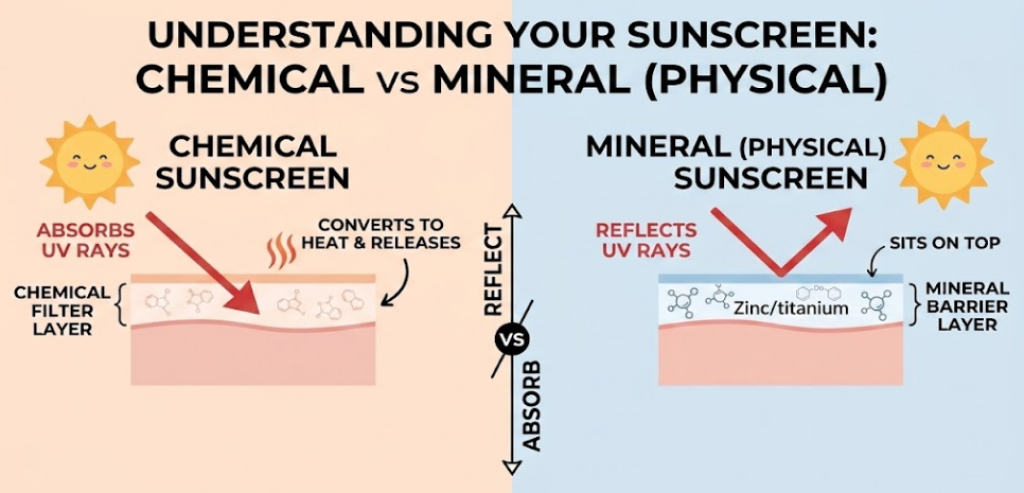
- Mineral Sunscreen uses physical blockers (Zinc Oxide or Titanium Dioxide) that sit on top of the skin to reflect UV rays like a mirror. It is ideal for sensitive skin, children, and those who want immediate protection.
- Chemical Sunscreen uses carbon-based filters (like Avobenzone or Oxybenzone) that absorb UV rays like a sponge and convert them into heat. It is best for those who want an invisible finish, athletes who need water-resistance, and deep skin tones.
Both provide excellent SPF protection, but their “personality” on your skin is completely different.
What Is Mineral Sunscreen? (The Physical Shield) 🛡️
Often referred to as “physical sunscreen,” mineral formulas are the old-school heroes of sun safety. They rely on two primary active ingredients: Zinc Oxide and Titanium Dioxide.
Because these minerals are large particles, they don’t typically sink into your pores. Instead, they form a protective film on the surface of your skin. This is why mineral sunscreens are often thicker and can be harder to rub in. The moment you see that white cream on your face, you are protected. There is no “wait time” required before you step out into the sun, making them the ultimate “apply and go” choice.
What Is Chemical Sunscreen? (The Invisible Filter) 🧪
Chemical sunscreens are the modern, “high-tech” cousins in the SPF family. They use a cocktail of ingredients that are designed to be absorbed into the top layer of your skin.
When UVA and UVB rays hit your skin, the chemical filters (such as avobenzone or octisalate) catch the radiation before it can reach your DNA. They transform that energy into a tiny amount of heat, which is then released from the skin. Because these ingredients are soluble, they can be formulated into incredibly thin, watery, or gel-like textures. This makes them the favorite of anyone who wears makeup or hates the feeling of “heavy” skincare products. 🕊️
How SPF and Broad Spectrum Actually Work ☀️
Before we compare the two types, we have to understand the metrics. You see “SPF 30” or “broad spectrum sunscreen” on every bottle, but what does that actually mean for your cells?
- UVB (Burning Rays): These rays hit the surface of your skin and cause redness and sunburns. The SPF number tells you how long it would take for UVB rays to redden your skin compared to if you weren’t wearing any.
- UVA (Aging Rays): These are the “silent” rays. They penetrate deep into the dermis, breaking down collagen and causing wrinkles and hyperpigmentation.
- The Broad Spectrum Seal: A sunscreen only earns this label if it protects against both UVA and UVB. In the mineral vs chemical sunscreen debate, mineral blockers are naturally broad-spectrum, while chemical formulas must be carefully blended to cover both bases.
9 Key Differences That Change Your Skin Game 🔄
This is the core of the decision-making process. These nine factors are why most people eventually choose a “side” in the sunscreen war.
1. Protection Mechanism (Reflect vs. Absorb)
Mineral sunscreens act like a mirror; they sit on top and bounce the rays away. Chemical sunscreens act like a sponge; they soak the rays up and turn them into heat. If you have a condition like rosacea where heat makes your skin flare up, the “sponge” method might cause more redness.
2. Skin Sensitivity & Irritation
Mineral blockers like zinc oxide are so gentle they are the primary ingredient in baby diaper rash creams. Chemical filters, however, can sometimes cause a “stinging” sensation, especially around the eyes or on broken skin.
3. Acne & Pore-Clogging Risk
Chemical sunscreens are usually thinner, making them feel “oil-free.” However, some mineral sunscreens are becoming more sophisticated and “non-comedogenic,” meaning they won’t trigger a sunscreen clogged pores disaster if you wash them off properly.
4. White Cast vs. Invisible Finish
The “ghost look” is the biggest complaint with mineral SPF. Since zinc is a white powder, it shows up on the skin. Chemical SPF is transparent, making it the winner for deep skin tones or those who don’t want to look like they’re wearing stage makeup. 👻
5. Environmental Impact (Reef Safety)
This is a huge topic in 2026. Ingredients like oxybenzone and octinoxate (found in many chemical SPFs) have been linked to coral bleaching. Many travelers now prefer reef-safe sunscreen (mineral) to protect the oceans. 🌊
6. Photostability (Sun Breakdown)
Mineral sunscreens are stable; they don’t “die” when the sun hits them. Some older chemical filters can break down after an hour of intense exposure, which is why reapplication is so critical for them.
7.Application & Reapplication
Mineral works immediately. Chemical requires a 15-20 minute wait time to “set” in your skin before you go outside. If you’re rushing out the door, the mineral shield is your best friend.
8. Suitability for Dark Skin Tones
For a long time, mineral SPF was a “no-go” for people of color. While tinted mineral options exist now, chemical sunscreen remains the most reliable way to get high protection with zero ashy residue.
9. Safety Concerns & Ingredient Debate
There is ongoing discussion regarding how much chemical SPF is absorbed into the bloodstream. While the FDA still considers them safe, those who prefer “clean beauty” often gravitate toward the mineral “physical” barrier for peace of mind.
Which Is Better for Sensitive Skin? 🧘♀️
If your skin turns red at the mere thought of a new product, the mineral vs chemical sunscreen debate has a clear winner.
Mineral sunscreens are the gold standard for sensitive skin. Because zinc oxide and titanium dioxide are inert minerals, they do not react with the skin or cause the “stinging” sensation often associated with chemical filters. They sit on the surface, acting as a physical buffer. If you suffer from eczema, rosacea, or melasma, a mineral formula will provide the SPF protection you need without triggering an inflammatory flare-up.
Which Sunscreen Is Better for Acne-Prone Skin? 🌋
This is where the choice gets a bit more personal. For years, people with acne avoided mineral SPF because it felt “thick” and “pasty.” However, modern formulations have changed the game.
- The Mineral Case: Zinc oxide actually has anti-inflammatory properties that can help soothe active breakouts. Look for “oil-free” or “non-comedogenic” mineral fluids.
- The Chemical Case: Because chemical formulas are often more “water-like” and absorb completely, they are less likely to feel heavy or greasy during a long day.
If your acne is triggered by heat, mineral is better. If your acne is triggered by heavy textures, a lightweight chemical gel might be your best bet. Regardless of your choice, the key is ensuring you remove sunscreen at night to prevent congestion.
Do Dermatologists Prefer Mineral or Chemical Sunscreen? 🩺
If you ask ten dermatologists, you might get ten different brand recommendations, but their core advice is usually the same: “The best sunscreen is the one you will actually wear.”
Most dermatologists lean toward mineral options for patients with skin conditions or those who are pregnant. However, they also recognize that “compliance” is the most important factor. If a patient hates the white cast of a mineral cream and stops wearing it, that patient is at risk. For this reason, many experts suggest chemical sunscreens for high-intensity outdoor activities and mineral sunscreens for daily facial wear.
Is Chemical Sunscreen Harmful? 🧪
There has been significant “fear-mongering” online regarding chemical sunscreen ingredients to avoid. Ingredients like oxybenzone have come under fire for their potential to be absorbed into the bloodstream.
Here is the honest truth: while the FDA has requested more data on long-term absorption, there is currently no clinical evidence that these ingredients cause harm to human health at the levels used in SPF. On the other hand, we have decades of concrete evidence that UV rays cause skin cancer and premature aging. If you are concerned about absorption, stick to mineral. If you prefer the finish of chemical, current medical consensus still supports its safety for daily use.
Mineral Sunscreen Pros and Cons ⚖️
To make your decision easier, let’s look at the “Physical Shield” through a balanced lens. Mineral formulas have come a long way, but they still have distinct personality traits.
The Pros:
- Immediate Action: You are protected the second it touches your skin.
- Safe for Everyone: The top choice for babies, pregnant women, and hyper-sensitive skin.
- Photostability: It doesn’t lose its “power” while sitting in the sun.
- Soothing: Zinc oxide helps calm skin redness and inflammation.
The Cons:
- The White Cast: Can leave a chalky or “purple” tint on darker skin tones.
- Thicker Texture: Can feel “heavy” or difficult to spread.
- Easier to Rub Off: Since it sits on top, it can be wiped away by a towel or sweat more easily than chemical versions.
Chemical Sunscreen Pros and Cons 🧪
Chemical filters are the “invisible” workhorses of the skincare world, but they aren’t without their quirks.
The Pros:
- Invisible Finish: Completely clear on all skin tones—no “ghost” effect.
- Easy Application: Thinner, spreadable textures that feel like a luxury serum.
- High Performance: Generally stays on better during swimming or high-intensity exercise.
- Space for Actives: Easier to formulate with other skincare ingredients like antioxidants.
The Cons:
- Wait Time: You must wait 15–20 minutes before sun exposure.
- Irritation Risk: Higher chance of stinging eyes or allergic reactions.
- Heat Trapping: By converting UV to heat, it may worsen conditions like rosacea.
SPF 30 vs. SPF 50: Does It Really Matter? 🔢
One of the biggest sunscreen mistakes is assuming SPF 100 is twice as good as SPF 50. The math of sun protection is a bit surprising:
- SPF 15 blocks about 93% of UVB rays.
- SPF 30 blocks about 97% of UVB rays.
- SPF 50 blocks about 98% of UVB rays.
The jump from 30 to 50 only gives you a 1% increase in actual protection. Why does this matter? Because people often use a higher SPF as an excuse to apply less or stay out longer. In the mineral vs chemical sunscreen debate, the amount you apply is far more important than the number on the bottle. Whether you choose 30 or 50, you still need about a nickel-sized amount for your face alone.

How to Choose the Right Sunscreen for Your Skin 🎯
Still undecided? Use this quick “lifestyle match” to find your winner:
- If you have Melasma or Rosacea: Go Mineral. The heat-release of chemical SPF can trigger more pigmentation and redness.
- If you are an Outdoor Athlete: Go Chemical. The water-resistance and “grip” are usually superior for heavy sweating.
- If you wear Makeup daily: Go Chemical (or a tinted mineral). It won’t pill or create a thick layer under your foundation.
- If you are “Eco-Conscious”: Go Mineral. It is the most reliable way to ensure you are using a reef-safe sunscreen.
Common Sunscreen Mistakes People Make 🚩
Even after settling the mineral vs chemical sunscreen debate, many people still fail to get the protection they paid for. Avoid these common pitfalls to keep your skin safe:
- Under-Applying: Most people use only a quarter of the required amount. You need about half a teaspoon for your face and neck combined.
- The “One and Done” Fallacy: Sunscreen isn’t a morning-only event. If you are outdoors, you must reapply every two hours, regardless of whether you chose mineral or chemical.
- Forgetting the “Hidden” Spots: Your ears, the back of your neck, and your hairline are the most common places where dermatologists find sun damage. 👂
- Using Expired Product: Sunscreen filters break down over time. If that bottle has been in your car since last summer, the SPF protection is likely gone.
Honest Truth: The Best Sunscreen Is the One You’ll Actually Use 🤝
We can argue about zinc oxide versus avobenzone all day, but the honest truth is that the “perfect” sunscreen on paper is useless if it sits in your drawer.
If you buy a mineral sunscreen because it’s “safer” but hate the way it makes you look like a ghost, you won’t wear it. If you buy a chemical sunscreen but it stings your eyes every time you sweat, you’ll find excuses to skip it. Don’t let the pursuit of the “ultimate” formula stop you from daily protection. Whether it’s a $10 drugstore chemical spray or a $50 luxury mineral tint, the only sunscreen that prevents cancer and wrinkles is the one currently on your face.
FAQs: Sunscreen Myths vs. Facts 🔍
Which is safer: mineral or chemical sunscreen?
Both are regulated and safe for use. However, mineral is generally preferred for babies and those with high skin sensitivity or “clean beauty” preferences.
Does higher SPF mean better protection?
Only marginally. SPF 50 blocks 98% of rays compared to 97% for SPF 30. The key is how much you apply and how often you reapply.
Are chemical sunscreens bad for the environment?
Some ingredients (like oxybenzone) are linked to coral reef damage. If you are swimming in the ocean, look for a certified reef-safe sunscreen (usually mineral-based). 🌊
Can sunscreen block Vitamin D?
In theory, yes, but in reality, most people don’t apply enough sunscreen to perfectly block all UV rays. A few minutes of sun on your arms is usually enough for Vitamin D synthesis.
Final Verdict: Mineral or Chemical—Which One Should You Pick? 🏁
The winner of the mineral vs chemical sunscreen battle depends entirely on your “skin resume.”
- Choose Mineral if: You have sensitive skin, rosacea, or are looking for a pregnancy-safe option. It’s a physical shield that works instantly.
- Choose Chemical if: You have a deeper skin tone, wear makeup daily, or need a formula that won’t budge during a workout. It’s the invisible filter for a modern lifestyle.
At the end of the day, your skin is unique. Don’t be afraid to mix and match—perhaps a mineral tint for your face and a chemical spray for your body. As long as you’re covered, you’re winning the skin game! 🌟✨
📚 References
- Mineral v chemical sunscreen: Which one should you be using?
- The Difference Between Mineral and Chemical Sunscreens
- Systemic Absorption of Sunscreen – Balancing Benefits With Unknown Harms
- Sunscreen Secrets Big Brands Don’t Want You to Know: Why Mineral Sunscreen Wins Every Time