Have you ever spent weeks at the gym, eating clean and staying disciplined, only to step on the scale and see the exact same number staring back at you? It is incredibly frustrating. You might feel like your hard work is going to waste, but the scale often hides the most important progress of all. While visible “belly fat” is what most of us worry about, the real danger—and the first thing to leave when you get healthy—is the fat you cannot see. This is called visceral fat. Recognizing the signs of visceral fat loss is crucial because this “hidden” progress happens internally long before you notice a change in the mirror. 腹
Visceral fat is the deep abdominal fat that wraps around your vital organs, including your liver, intestines, and pancreas. Because it is buried deep inside your torso, losing it doesn’t always result in an immediate drop in weight. However, as this toxic fat melts away, your body begins to function differently. You might notice your energy returning, your sleep deepening, or your clothes fitting better around the waist. In this guide, we will explore the clear signs of visceral fat loss so you can stay motivated, even when the scale refuses to budge.

What Is Visceral Fat (In Simple Terms)? 🫀
Before we dive into the signs of visceral fat loss, we need to define the enemy. Not all fat is created equal. Most of the fat we see and pinch—on our arms, legs, or chin—is subcutaneous fat. Visceral fat, however, is much more sinister. It is often referred to as deep abdominal fat because it occupies the spaces between your abdominal organs.
- The Internal Cushion: A tiny amount of visceral fat is actually normal; it acts as a cushion for your organs. The problem starts when your body stores too much of it due to poor diet or high stress.
- A “Living” Organ: Unlike the fat under your skin, visceral fat is metabolically active. It acts like an extra organ, pumping out inflammatory chemicals and hormones that interfere with your natural biology.
- The Relatable Analogy: Think of subcutaneous fat like a backpack you are carrying—it’s heavy and annoying. Visceral fat, however, is like a fire burning inside the backpack. It does much more damage to the person carrying it.
Visceral Fat vs. Subcutaneous Fat: The Quick Comparison 📊

Understanding the difference between visceral fat vs subcutaneous fat is the key to managing your expectations during weight loss. They respond differently to diet, exercise, and hormonal changes.
| Feature | Subcutaneous Fat | Visceral Fat (Deep Fat) |
| Location | Directly under the skin | Deep inside the abdomen 🫁 |
| Visibility | Easy to see and “pinch” | Mostly hidden; creates a “firm” belly |
| Health Risk | Lower (mostly aesthetic) | High (linked to heart disease & diabetes) |
| Ease of Loss | Slower to burn | Drops faster with exercise and diet |
| Metabolic Activity | Low | High (produces inflammatory cytokines) |
The good news? Because visceral fat is so metabolically active, it is often the first type of fat your body burns when you start a healthy regimen. This is why you might feel significantly better internally even if your “love handles” are still there.

Why Losing Visceral Fat Matters More Than Weight Loss 🏆
Most people focus on the scale, but metabolic health is the real prize. If you lose five pounds of muscle but keep your visceral fat, you haven’t actually made yourself healthier. Conversely, if the scale stays the same but you replace visceral fat with lean tissue, your lifespan and energy levels will skyrocket.
- Reducing Chronic Inflammation: Visceral fat is a primary source of systemic inflammation. As you lose it, you are literally “cooling down” your body’s internal environment.
- Organ Function: When deep fat packs tightly around your liver and pancreas, it impairs their ability to filter toxins and manage blood sugar. Reducing this pressure allows your organs to “breathe” and function efficiently.
- Heart Protection: High levels of visceral fat are directly linked to clogged arteries and high blood pressure. Losing even a small percentage of this fat significantly lowers your risk of a cardiac event.
7 Signs of Visceral Fat Loss 🔍
If you are looking for signs of visceral fat loss, you have to look beyond the general “weight loss” narrative. Because this fat is packed tightly inside your abdominal cavity, its departure triggers specific physical and metabolic shifts. Here is how to tell if your body is successfully burning off that deep, dangerous fat.
1. Your Waist Circumference Is Shrinking 📏
The most reliable way to track belly fat reduction signs is with a simple measuring tape, not a scale. While subcutaneous fat is squishy and hangs off the body, visceral fat creates a “firm” or “hard” protruding belly. As this internal pressure decreases, your waistline is the first place to show it.
- The Measurement Test: Wrap a tape measure around your natural waistline (just above the belly button). If you see the inches dropping even while the scale stays still, you are successfully losing deep abdominal fat.
- The “Pants” Benchmark: Have you noticed your belt needs a new hole, or your favorite jeans are suddenly gaping at the waist? This is a classic indicator that the internal volume of your abdomen is decreasing.
2. You Feel More Energized Throughout the Day ⚡
One of the most immediate signs of visceral fat loss is a sudden boost in daily stamina. Visceral fat isn’t just sitting there; it actively produces inflammatory cytokines that cause systemic fatigue.
- Metabolic Efficiency: When you carry less fat around your liver and pancreas, your body becomes better at converting food into fuel. Instead of feeling sluggish after lunch, you might find your energy levels remain stable until evening.
- Reduced “Heavy” Feeling: Many people describe a sense of “lightness” in their core as they lose internal fat. Moving, walking, and even standing feel less like a chore.
3. Your Blood Sugar Levels Stabilize 🩸
Losing deep fat around vital organs has a direct, positive impact on your insulin resistance. This leads to much smoother blood sugar regulation.
- Fewer Sugar Cravings: When your blood sugar is stable, those intense, shaky cravings for sweets or simple carbs begin to vanish.
- No More “Hangry” Episodes: If you can go longer between meals without feeling irritable or lightheaded, it is a strong signal that your metabolic health is improving as your visceral fat stores shrink.
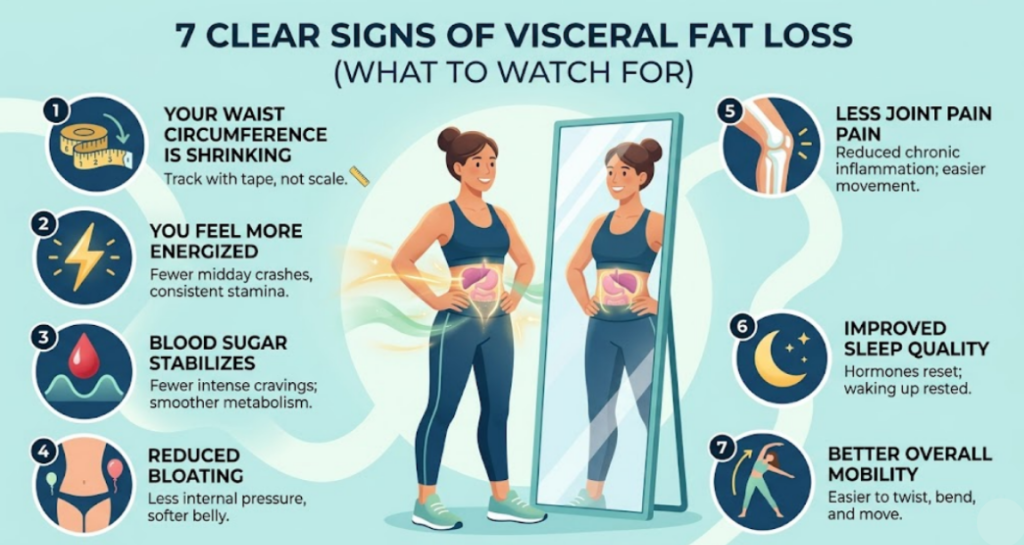
4. Reduced Bloating and Firmness in the Belly 🎈
Does your stomach feel “tight” or “rock hard” to the touch? That is often a sign of high visceral fat combined with internal inflammation.
- Less Internal Pressure: As you lose this fat, the “push” against your abdominal wall decreases. Your belly will feel softer and look flatter, especially in the morning.
- Digestive Ease: Because there is less fat crowding your intestines, many people report fewer bouts of bloating and a more “regular” digestive rhythm.
5. You Experience Less Joint Pain 🦵
It might seem strange to link signs of visceral fat loss to your knees or lower back, but the connection is scientific.
- Inflammation Reduction: Visceral fat pumps out inflammatory chemicals that travel through your bloodstream and settle in your joints. As this fat melts away, systemic inflammation drops, often leading to a noticeable reduction in chronic aches and pains.
- Less “Center of Gravity” Strain: Reducing internal belly fat shifts your center of gravity back to a neutral position, taking immense pressure off your lumbar spine.
6. Improved Sleep Quality 🌙
If you find yourself waking up feeling actually rested, thank your shrinking fat cells.
- Hormone Balance: Visceral fat disrupts the balance of cortisol (your stress hormone) and insulin. Lowering this fat helps reset your circadian rhythm.
- Easier Breathing: Large amounts of internal fat can push against the diaphragm, making breathing shallower, especially when lying down. Losing it can even improve mild cases of sleep apnea.
7. You Notice Better Overall Mobility 🧘
Can you tie your shoes without holding your breath? Can you twist in your seat more easily?
- Range of Motion: Removing the “internal padding” of visceral fat allows your core to move through its full range of motion.
- Easier Daily Movement: Getting in and out of a car or walking up a flight of stairs becomes significantly easier when your vital organs aren’t “squeezed” by excess fat.
Can You Lose Visceral Fat Without Losing Weight? ⚖️
One of the most confusing parts of the journey is seeing signs of visceral fat loss while the number on the scale refuses to budge. How is that possible? It comes down to a process called body recomposition.
- Muscle vs. Fat Density: Muscle is significantly denser than fat. If you are lifting weights or eating a high-protein diet, you might be gaining a pound of muscle for every pound of visceral fat you lose. Since muscle takes up much less space, your waist shrinks even if your weight stays exactly the same.
- Water Retention Shifts: As you cut out processed sugars and reduce internal inflammation, your body drops “water weight.” This can mask fat loss on the scale for weeks at a time.
- The “Internal Shift”: Remember, visceral fat is hidden. You could lose two pounds of fat from around your liver and heart, and while your health markers improve drastically, it won’t show up as a “slimmer look” in your face or arms yet. 📉
What Causes Visceral Fat to Build Up? 🍔

To recognize the signs of visceral fat loss, you first have to understand what invited the fat to your internal organs in the first place. It isn’t just about “eating too much”; it is about what and how you eat and live.
- Refined Sugars and Fructose: Unlike other fuels, high amounts of fructose are processed almost exclusively in the liver. When the liver is overwhelmed, it shunts that energy into deep abdominal fat storage.
- Chronic Stress (The Cortisol Connection): High stress levels keep your cortisol elevated. Cortisol is a “fat-storage hormone” that specifically tells your body to pack energy into the visceral cavity to protect your organs from a perceived threat. 🧠
- Sedentary Lifestyle: Without movement, your body has no reason to pull energy from its deep internal stores. Over time, these stores become “stagnant” and inflammatory.
- Poor Sleep: Losing just one or two hours of sleep a night can spike your hunger hormones (ghrelin) and drop your “fullness” hormones (leptin), making you crave the exact foods that build visceral fat.
How Visceral Fat Affects Your Energy Levels 💤
If you are constantly tired, your deep abdominal fat might be to blame. This fat isn’t a passive storage tank; it is a chemical factory that disrupts your stamina.
- Hormonal Sabotage: Visceral fat produces cytokines like Interleukin-6, which cause low-grade, constant inflammation. This leaves your immune system “on guard” 24/7, which is physically exhausting. 🛡️
- Mitochondrial Sluggishness: High levels of internal fat can interfere with how your mitochondria—the power plants of your cells—produce energy. This is why you might feel “heavy” or “slow” even after a full night of sleep.
- The Fatigue Link: As you notice the signs of visceral fat loss, you will likely feel a “lifting” of this brain fog and physical lethargy. It is one of the most rewarding parts of the process.
Does Losing Visceral Fat Improve Insulin Sensitivity? 🩸
The answer is a resounding yes. In fact, reducing visceral fat is the single most effective way to reverse insulin resistance and prevent Type 2 diabetes.
- Direct Metabolic Benefits: When you lose fat from around the pancreas and liver, those organs can finally communicate with your blood sugar properly. Your pancreas doesn’t have to pump out massive amounts of insulin just to move a little bit of sugar into your cells.
- Breaking the Cycle: High insulin levels actually prevent fat burning. By losing visceral fat, you lower your baseline insulin, which makes it even easier for your body to burn more fat in the future. It is a positive feedback loop for your health. 🔄
- Diabetes Prevention: For many, the signs of visceral fat loss are the first indicators that they are successfully moving away from the “danger zone” of metabolic syndrome.
Waist Size Guidelines for Men and Women 📏
When tracking the signs of visceral fat loss, the tape measure is your most honest friend. While the scale tells you how much “stuff” is inside your body, the tape measure tells you where that stuff is located. Because deep abdominal fat pushes the stomach outward, your waist circumference is the gold standard for measuring internal health risk.
- The Risk Threshold for Men: Research suggests that men with a waist circumference over 40 inches (102 cm) are at a significantly higher risk for heart disease and Type 2 diabetes. 🧔
- The Risk Threshold for Women: For women, the “danger zone” typically begins at 35 inches (88 cm).
- The Progress Benchmark: You don’t need to hit the “ideal” number overnight. Losing just one inch from your waist is a massive victory. It represents a significant reduction in the pressure on your internal organs and a major win for your metabolic health. 📉
The Honest Truth: Fat Loss Isn’t Always Visible First 💡
It is a common myth that you will see your “abs” the moment you start losing fat. The reality of internal fat loss indicators is that your body prioritizes its own survival over your summer beach body.
- The “Safety First” Principle: Your body is incredibly smart. It often chooses to burn the dangerous visceral fat around your heart and liver before it touches the “pinchable” subcutaneous fat on your hips or thighs.
- Why You Look “The Same”: You might lose two inches of internal fat—drastically improving your blood pressure and energy—but because the outer layer of fat is still there, you might not “see” the change in the mirror yet. 🪞
- Stay the Course: This is the “honest truth” that most people miss. If you feel better, sleep deeper, and have more energy, it is working. The visual changes are simply lagging behind the internal healing.
How Fast Can You Lose Visceral Fat? ⏳
We live in a world of “overnight transformations,” but signs of visceral fat loss follow a more natural, sustainable pace. The good news? Visceral fat is often the most “eager” to leave.
- The 2-Week Mark: Within the first 14 days of a clean, lower-carb, high-protein diet, your liver fat can drop significantly. You might feel less “puffy” and notice your digestion improving.
- The 30-Day Shift: After a month of consistency, most people see a visible difference in their waist circumference. This is usually when your belt starts to feel a bit looser.
- The 90-Day Transformation: By three months, your blood work (like A1C and triglycerides) will likely reflect the massive reduction in internal fat. Consistency is the only “secret” here. 🏃♂️
Best Ways to Reduce Visceral Fat 🛠️

If you aren’t seeing the signs of visceral fat loss yet, it might be time to tweak your strategy. You cannot “spot reduce” belly fat with crunches, but you can “metabolically reduce” it with these five pillars:
- Prioritize High-Protein Meals: Protein has a high thermic effect and keeps you full. More importantly, it helps maintain muscle mass so your body is forced to burn fat for fuel. 🥩
- Incorporate Strength Training: Building muscle increases your resting metabolic rate. It also improves insulin sensitivity, making it harder for your body to store fat around your organs.
- The “Daily 10k” Walk: Low-intensity steady-state (LISS) cardio, like walking, is a powerful tool for lowering cortisol. High cortisol is a major driver of deep abdominal fat accumulation. 🚶♀️
- Manage Your Stress Levels: You cannot “diet” your way out of a high-stress lifestyle. Meditation, deep breathing, or even just a hobby can lower the cortisol that keeps that “firm” belly fat locked in place.
- Optimize Your Sleep: Aim for 7-9 hours of quality rest. Sleep is when your hormones reset. Without it, your body stays in “survival mode,” clinging to every calorie of visceral fat it has. 💤
Special Case: Losing Abdominal Fat After Menopause 🌸
For many women, the signs of visceral fat loss become harder to spot during and after menopause. This is due to a significant shift in hormonal balance—specifically the decline of estrogen.
- The Hormonal Shift: Estrogen naturally encourages fat storage in the hips and thighs (subcutaneous fat). As levels drop, the body begins to prioritize storing fat in the abdominal cavity. This “menopausal middle” is almost entirely composed of deep abdominal fat. 📉
- The Adjusted Strategy: Traditional “cardio-only” approaches often fail here because they can spike cortisol. To see progress, menopausal women often need to prioritize strength training to maintain muscle mass and focus on insulin sensitivity through a lower-carb, higher-protein diet.
- Patience is Key: The internal healing happens first. You may notice your energy returning and your sleep improving long before the “middle” begins to shrink. 🧘♀️
Foods That Help Burn Visceral Fat: Your Grocery List 🛒

While you cannot “spot-reduce,” certain foods are scientifically proven to help your body access and burn deep fat around vital organs.
- Fiber-Rich Vegetables: Soluble fiber (found in beans, oats, and flaxseeds) absorbs water and forms a gel that slows down digestion. This prevents the insulin spikes that drive visceral fat storage. 🥦
- Healthy Fats (Omega-3s): Fatty fish like salmon and mackerel are rich in Omega-3 fatty acids, which have been shown to reduce systemic inflammation and help “mobilize” stubborn internal fat.
- Lean Protein Sources: High-quality protein (eggs, chicken, Greek yogurt) has a high thermic effect. Your body burns more calories just digesting protein than it does digesting fats or carbs. 🥩
- Probiotic Foods: A healthy gut microbiome is essential for metabolic health. Foods like kimchi, sauerkraut, and kefir help balance the bacteria that regulate how you store fat.
Common Mistakes That Slow Visceral Fat Loss 🚫
If you aren’t seeing the signs of visceral fat loss despite your best efforts, you might be falling into one of these common “health traps”:
- Chronic Crash Dieting: Eating too few calories sends your body into “survival mode.” It will cling to its internal fat stores to protect your organs and instead burn through your muscle tissue for energy. 📉
- Ignoring Liquid Calories: You can eat perfectly, but if you are drinking soda, “healthy” fruit juices, or excessive alcohol, your liver is being flooded with fructose. This is the fastest way to build visceral fat.
- Over-Exercising Without Rest: If you are doing high-intensity workouts every single day without adequate sleep, your cortisol levels will remain chronically high, locking your deep abdominal fat in place. 😴
FAQs: Your Visceral Fat Questions Answered 💡
What are the first signs of losing visceral fat?
The very first signs are usually internal: improved energy, more stable blood sugar (fewer “hangry” moments), and better sleep quality. A shrinking waistline usually follows shortly after.
Why is visceral fat dangerous?
Unlike the fat under your skin, visceral fat is metabolically active. It produces hormones and inflammatory proteins that can lead to heart disease, Type 2 diabetes, and chronic inflammation. 🫀
Is visceral fat easier to lose than subcutaneous fat?
Yes! Because it is closer to the liver and highly metabolically active, your body can access and burn visceral fat much faster than the “stubborn” fat on your hips or arms.
Can walking reduce visceral fat?
Absolutely. Walking is a low-stress exercise that burns fat without spiking cortisol, making it one of the best ways to reduce deep fat over the long term. 🚶♂️
Final Verdict: Are You Actually Losing Visceral Fat? 🏁
If you have been looking for signs of visceral fat loss, remember that the scale is only one small piece of the puzzle. If your waist is shrinking, your energy is high, your blood sugar is stable, and you are sleeping like a baby—it is working. 🏆
Losing deep abdominal fat is a marathon, not a sprint. By focusing on metabolic health rather than just a “goal weight,” you are setting yourself up for a longer, more vibrant life. Stay consistent, trust the internal process, and celebrate every inch lost as a major victory for your heart and mind.
References
- The Relationship Between Visceral Fat and Inflammation
- Visceral Fat: What It Is and How to Get Rid of It
- Belly Fat in Women: Skinnier Waist, Better Health
- Visceral Adiposity and Metabolic Risk