You’ve seen it on every treadmill and elliptical at the gym: the “Fat-Burning Zone.” It promises that if you keep your heart rate in a specific, low-intensity range, you’ll melt away body fat faster than any other method. It sounds perfect—less effort for more results. Most people spend months walking at a brisk pace, watching the “fat calories burned” counter climb, yet they never see a change in the mirror.
This is the ultimate frustration in the fitness world. The reason you feel stuck isn’t a lack of effort; it’s a misunderstanding of the fundamental fat loss vs fat oxidation debate. We have been sold the idea that burning fat as fuel during a workout is the same thing as losing body fat from our waistlines. Unfortunately, these two biological processes are worlds apart. If you want to stop spinning your wheels, you need to know why “fat-burning” is often a distraction from actual fat loss.

Quick Answer: Fat Loss vs Fat Oxidation ⚡
If you want the “bottom line” on the difference between fat oxidation and fat loss, here is the simple breakdown:
- Fat Oxidation is the process of your body burning fat for fuel right now. It is a metabolic transaction where fat is converted into energy (ATP) to power your muscles during a walk, a run, or even while you sleep.
- Fat Loss is the long-term reduction of total body fat stores. This only happens when you maintain a calorie deficit over time, forcing your body to tap into its “savings account” (adipose tissue) because it isn’t getting enough energy from food.
In short: Oxidation is about fuel usage, while loss is about energy balance. You can burn a massive amount of fat during a workout (high oxidation) and still gain weight if you eat more than you burn.
What Is Fat Oxidation? 🧪
At its core, fat oxidation is a chemical process. When you move, your body needs energy. It gets this energy by breaking down macronutrients—mostly fats and carbohydrates. Through a series of steps called beta-oxidation, fatty acids are broken down in the mitochondria (the powerhouses of your cells) to create fuel.
This happens every single second of the day. Even as you read this, your body is oxidizing a blend of fat and sugar. During low-intensity exercise, like a slow hike or cleaning the house, your body prefers fat because it’s an abundant, slow-burning fuel source. However, just because you are “using fat” for a task doesn’t mean that fat is coming from your belly; it could easily be the fat you just ate for breakfast.
What Is Fat Loss? 📉
Fat loss is the actual physical shrinking of your fat cells. Your body stores excess energy as triglycerides inside fat tissue. To lose this fat, you must create a scenario where the energy leaving your body is greater than the energy entering it.
When a calorie deficit is present, your body realizes it has a “shortfall.” It releases hormones like adrenaline and glucagon that tell your fat cells to release their stored energy into the bloodstream. This is a global process, not a local one. While oxidation happens in the muscle cell, fat loss is a total-body management system. You don’t just want to “burn” fat; you want to ensure that, by the end of the day, your body has used more energy than it took in.
Why Burning Fat During Exercise Doesn’t Guarantee Fat Loss 🛑
This is the “aha” moment for most fitness enthusiasts. The fat burning workout myth persists because we focus on the wrong clock. We look at what we burn during the 60 minutes we are at the gym, but we ignore the other 23 hours of the day.
If you do a low-intensity workout that burns 300 calories—mostly from fat—your body will compensate later in the day by burning more carbohydrates. Conversely, if you do a high-intensity workout that burns 500 calories—mostly from sugar—your body will actually oxidize more fat during the rest of the day to recover. Total energy expenditure and your post-workout metabolic balance matter significantly more than the “fuel type” you used during the actual exercise. You can win the “fat-burning” battle during your workout and still lose the “fat loss” war by lunchtime.
How Your Body Chooses Between Fat and Carbs 🔄
To master the fat loss vs fat oxidation puzzle, you have to understand your body’s internal “fuel selector” switch. Your metabolism is remarkably flexible. It constantly assesses two things: how much oxygen you have available and how fast you need energy. Think of it like a hybrid engine that switches between an electric battery (fats) and high-octane gasoline (carbohydrates).
When you are sitting on the couch or going for a light stroll, you have plenty of oxygen. Fat is a dense fuel source that requires a lot of oxygen to break down, so your body happily “oxidizes” fat during these low-intensity moments. However, the moment you start sprinting for a bus or lifting heavy weights, your demand for energy spikes. Fats burn too slowly to keep up with that demand. Consequently, your body flips the switch to glycogen (stored sugar). Sugar can be converted into energy much faster and with less oxygen. This “fuel switching” is a survival mechanism, but it’s also the reason why a “fat-burning workout” isn’t the magic bullet people think it is. Just because you aren’t burning fat at high speeds during a sprint doesn’t mean you aren’t losing fat in the long run.
7 Shocking Truths About Fat Loss vs Fat Oxidation ⚡
If you’ve been frustrated by a lack of progress, these seven truths will explain exactly why the numbers on your fitness tracker don’t always match the changes in your body. Understanding the difference between fat oxidation and fat loss requires looking at the “big picture” of human metabolism.
1. Low-Intensity Burns More Fat, But Fewer Calories
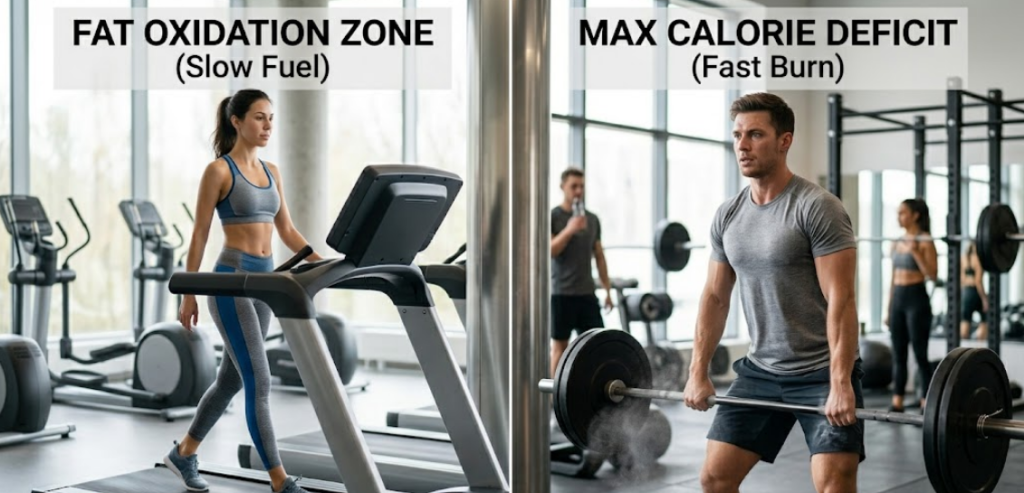
This is the heart of the “Fat-Burning Zone” confusion. It is true that at a lower heart rate, a higher percentage of the calories you burn comes from fat. You might burn 60% fat and 40% carbs while walking. However, the total number of calories burned is quite low. If you walk for thirty minutes, you might burn 150 calories. In contrast, a high-intensity session might burn only 30% fat during the session, but the total burn could be 400 calories. At the end of the day, the 400-calorie session creates a much larger dent in your energy stores, leading to more actual fat loss.
2. High-Intensity Burns More Calories Overall
Don’t be fooled by the “fuel source” label on the treadmill. High-intensity interval training (HIIT) or heavy lifting primarily burns glucose. But here is the kicker: high-intensity work creates an “oxygen debt” that your body has to pay back for hours after you leave the gym. This is known as Excess Post-exercise Oxygen Consumption (EPOC). While you are sitting at home recovering from a tough session, your body shifts into high-gear fat oxidation to repair muscle tissue and restore balance. You burn the sugar in the gym so you can burn the fat while you sleep.
3. You Can Burn Fat and Still Gain Fat
This is the most “shocking” truth of all. You can spend two hours in the perfect fat-burning zone, oxidizing 50 grams of fat, and still get fatter. How? If you consume 100 grams of fat in your diet that same day while staying in a calorie surplus, your body will simply store the extra. Your body is a master at balancing the books. High fat oxidation is a sign of what you are using for fuel, but it is not a sign that your fat cells are shrinking. Only a calorie deficit forces the body to pull energy from your permanent storage.
4. Fat Loss Happens Outside the Gym Too
Many people treat the gym like a “fat-burning furnace,” but your metabolic rate during the other 23 hours of the day is actually what dictates your success. Fat loss is a 24/7 process. If you spend one hour “burning fat” but the rest of your day is completely sedentary, your total daily energy expenditure (TDEE) will remain low. True fat loss is driven by your “Basal Metabolic Rate”—the energy you burn just to keep your heart beating and your brain functioning.
5. Diet Controls Fat Loss More Than Exercise
You’ve heard the saying, “You can’t out-run a bad diet,” and the science of fat loss vs fat oxidation proves it. Exercise is great for cardiovascular health and improving metabolic efficiency, but it is a relatively inefficient way to create a calorie deficit. It is much easier to not eat a 500-calorie muffin than it is to spend an hour on a stair-climber trying to burn it off. Exercise should be used to build muscle and health, while your fork should be used to manage fat loss.
6. “Fat-Burning Zone” Is Often Misleading
The “zone” exists, but its name is a marketing masterpiece. For athletes, training in this zone (often called Zone 2) is vital for building mitochondria and endurance. But for the average person trying to lose 20 pounds, the “Fat-Burning Zone” can lead to “efficiency traps.” Because the intensity is so low, your body doesn’t receive a strong enough stimulus to build muscle or significantly boost your metabolism. You become “good” at walking, but you don’t necessarily become “leaner.”
7. Metabolism Adapts Over Time
Your body is a survival machine, not a calculator. If you do the same “fat-burning” walk every single day, your body eventually becomes more efficient at it. You will actually start burning fewer calories to perform the same amount of work. This is why many people hit a weight-loss plateau. To keep fat loss moving, you have to keep your body guessing and constantly challenge your metabolic flexibility by varying your intensity and your diet.

What Is the Fat-Burning Zone 💓
If the “Fat-Burning Zone” is such a distraction for weight loss, why does every piece of cardio equipment still feature it? To understand this, we have to look at the aerobic threshold. The fat-burning zone generally refers to exercise performed at 60% to 70% of your maximum heart rate. At this specific intensity, your body is able to supply enough oxygen to the mitochondria to favor fat as the primary fuel.
Is it useful? Absolutely—but perhaps not for the reasons you think. For elite athletes and endurance enthusiasts, this is often called Zone 2 training. Training in this zone is the best way to build “metabolic base.” It increases the number and efficiency of your mitochondria, which improves your metabolic efficiency. While it might not be the fastest way to drop ten pounds this week, it makes your body better at using fat as a fuel source in the long run. If you are metabolically healthy, you can burn more fat while sitting at your desk or sleeping. So, the “zone” isn’t a lie; it’s just a long-term investment in your health rather than a short-term weight loss hack.
The Role of Calories: The Real Fat Loss Driver 📊
We often get lost in the weeds of “fat oxidation,” but we must never forget the law of thermodynamics. The calorie deficit remains the undisputed king of fat loss. Imagine your body is a large warehouse. Fat oxidation is simply the forklift moving crates (fat) from the shelf to the loading dock (the muscles) to be used.
However, if a new delivery truck (your meals) arrives at the back door with more crates than the forklift can move, the warehouse never gets emptier. It doesn’t matter how fast that forklift works; if the total inventory coming in exceeds the inventory going out, the warehouse grows. To achieve fat loss, you must ensure that the total energy “shipped out” via movement and your basal metabolic rate is higher than the energy “shipped in” through your mouth. This is why a person eating 1,500 calories of junk food and sitting on the couch can technically lose more fat than someone eating 3,000 calories of “clean” food and working out in the fat-burning zone for two hours.
Does Burning More Fat During Exercise Help Weight Loss? 🤔
This is one of the most common “People Also Ask” questions for a reason. The honest truth is: not necessarily. If you burn 40 grams of fat during a long, slow bike ride, your body will simply prioritize burning carbohydrates for the rest of the day to restore its glycogen stores.
In fact, some studies show that people who focus exclusively on high fat oxidation during exercise end up with an increased appetite, leading them to accidentally eat back those calories. Does burning more fat during exercise help weight loss? Only if that exercise contributes to a total daily energy deficit. If you find that “fat-burning” cardio makes you ravenously hungry and leads to a binge, you might actually be sabotaging your goals. The goal isn’t to burn fat during the session; it’s to create a metabolic environment where your body has no choice but to use its stores to keep you alive.

Best Workouts for Fat Loss (Not Just Fat Burning) 🏋️♂️
If you want to stop chasing “oxidation” and start seeing “loss,” you need a balanced approach. The best workouts for fat loss are those that build muscle and keep the metabolism elevated long after the shower.
- Resistance Training: Lifting weights is the ultimate fat-loss tool. Muscle tissue is metabolically expensive, meaning it burns more calories even when you are just watching TV. By increasing your muscle mass, you increase your “engine size,” which burns more fuel (both fat and carbs) 24/7.
- High-Intensity Interval Training (HIIT): These sessions are short but brutal. They don’t burn much fat during the work, but they create a massive metabolic disturbance that forces your body to oxidize fat at a higher rate during recovery.
- NEAT (Non-Exercise Activity Thermogenesis): This includes walking the dog, taking the stairs, and fidgeting. This often accounts for more total calorie burn than your actual gym session.
How to Increase Fat Oxidation 🏃♂️
While we’ve established that oxidation doesn’t equal loss, there are times when you want to increase fat oxidation—specifically for endurance performance and metabolic flexibility. If you are training for a marathon or a long-distance triathlon, you want your body to be a “fat-burning beast” so you don’t “bonk” when your sugar stores run low.
To improve this, focus on:
- Zone 2 Cardio: Consistent, long-duration exercise at a conversational pace.
- Fasted Training: Occasionally doing light cardio before breakfast can “teach” the body to rely on fat stores when glucose is low.
- Low-Carb Periods: Periodically reducing carbohydrate intake can force the body to ramp up its fat-oxidizing enzymes.
By doing this, you aren’t necessarily losing more weight, but you are becoming a more efficient athlete who can keep going long after others have run out of steam.
Common Mistakes That Kill Fat Loss Progress 📉
If you feel like you are doing everything right but the scale won’t budge, you are likely falling into one of the common traps of the fat loss vs fat oxidation confusion. Many people prioritize “effort” over “strategy,” leading to a metabolic stalemate.
- Overestimating Exercise Burn: Your treadmill might say you burned 600 calories, but these machines are notoriously inaccurate, often overestimating by up to 20-30%. If you use that number to justify a “reward meal,” you’ve just erased your entire deficit.
- Ignoring Liquid Calories: You can oxidize fat all morning, but if you have a “healthy” smoothie or a large latte with 400 calories in the afternoon, you’ve halted your fat loss progress. ☕
- The “Weekend Warrior” Syndrome: Being perfect Monday through Friday and then having a “cheat weekend” can easily wipe out a 500-calorie daily deficit. Consistency is the only thing that forces your body to tap into its long-term storage.
- Lack of Sleep: When you are sleep-deprived, your body’s metabolic efficiency drops. Your cortisol rises, making your body more likely to hold onto fat and burn through muscle tissue for energy instead.
Honest Truth: Your Workout Isn’t the Main Problem 🧠
The honest truth about fat loss vs fat oxidation is that most people overvalue the gym and undervalue the kitchen. You will spend roughly 3 to 5 hours a week in the gym, but you spend 168 hours a week living your life.
The gym is where you build the “machinery”—the muscle and the cardiovascular health. Your kitchen is where you manage the “inventory.” If you treat your workout as a way to “earn” your food, you will always be one step away from burnout. Instead, look at exercise as a way to make your body a more efficient, high-performing machine. True fat loss is a quiet, boring process of staying slightly hungry and moving consistently, not a loud, sweaty hour in a “fat-burning zone.” Stop looking for the “perfect workout” and start looking for the perfect lifestyle habits.
Simple Fat Loss Plan That Actually Works 📋
Ready to stop chasing shadows? Here is a fat loss strategy that ignores the myths and focuses on the science of energy balance and muscle preservation.
- Prioritize Protein: Eat 0.8g to 1g of protein per pound of body weight. Protein has a high “thermic effect,” meaning you burn more calories just digesting it, and it protects your muscle while you lose fat.
- Strength Train 3x a Week: Focus on big movements like squats, rows, and presses. This keeps your metabolic rate high and ensures the weight you lose comes from fat, not muscle.
- The “10k Step” Rule: Instead of killing yourself with high-intensity cardio, aim for 8,000 to 10,000 steps a day. This is a low-stress way to increase your total daily energy expenditure without making you ravenously hungry. 👟
- Eat Whole Foods: 80% of your diet should come from single-ingredient foods. This naturally lowers your calorie intake and improves your metabolic flexibility.
- Track Your Progress, Not Just Weight: Take photos and measure your waist. Because muscle is denser than fat, you might be losing fat even if the scale stays the same.
FAQs 🔍
Does burning more fat during exercise mean weight loss?
Not necessarily. Burning fat during exercise (fat oxidation) only means you are using fat as your primary fuel source in that moment. Total weight loss only happens if you are in a calorie deficit by the end of the day.
What is the fat-burning zone?
The “fat-burning zone” is a heart rate range (usually 60-70% of your max) where your body uses a higher percentage of fat for fuel. However, it burns fewer total calories than higher-intensity zones.
Can you lose fat without cardio?
Yes. Fat loss is driven by a calorie deficit. While cardio helps increase your energy expenditure, you can lose fat purely through diet and resistance training.
Why am I not losing fat despite working out?
The most common reason is that you are unknowingly eating back the calories you burn. Exercise can also cause temporary water retention, which hides fat loss on the scale.
Is low-intensity cardio better for fat loss?
It is better for fat oxidation and building endurance, but it isn’t necessarily better for fat loss. High-intensity work often burns more total calories, which is the real driver of long-term weight reduction.
Final Verdict: Stop Chasing Fat Burning, Focus on Fat Loss 🏁
The difference between fat oxidation and fat loss is the difference between winning a play and winning the championship. Don’t be seduced by the “fat-burning” labels on your treadmill or the high-fat-burning claims of certain diets.
If you want a lean, healthy body that lasts, focus on the big levers: a consistent calorie deficit, high protein intake, and resistance training. Use low-intensity cardio to improve your heart and your metabolic efficiency, but don’t expect it to do the heavy lifting for your weight loss. When you stop chasing the “burn” and start managing the balance, the results you’ve been looking for will finally start to show. 🚀🔥
References
- Fat Oxidation Rates During Exercise and Training
- The Role of Energy Balance in Weight Management
- Enhanced protein intake on maintaining muscle mass, strength, and physical function in adults with overweight/obesity
- Metabolic Adaptations to Exercise Training – Springer Nature